

Written and reviewed by doctors and medical students who have recently sat these exams. How we source and verify recall content.
Meta description: Active recall techniques for medical school: science-backed Anki plans, session templates, and quick fixes to build exam-ready retention. Start now.
Most medical students spend hours re-reading lecture slides, annotating textbooks, and watching the same video explanations twice. They finish a study session feeling productive, even confident. Then the exam arrives, and the knowledge simply isn’t there. The problem isn’t effort or intelligence. It’s the method: passive review creates a feeling of familiarity that the brain mistakes for mastery, and that illusion collapses under real exam pressure.
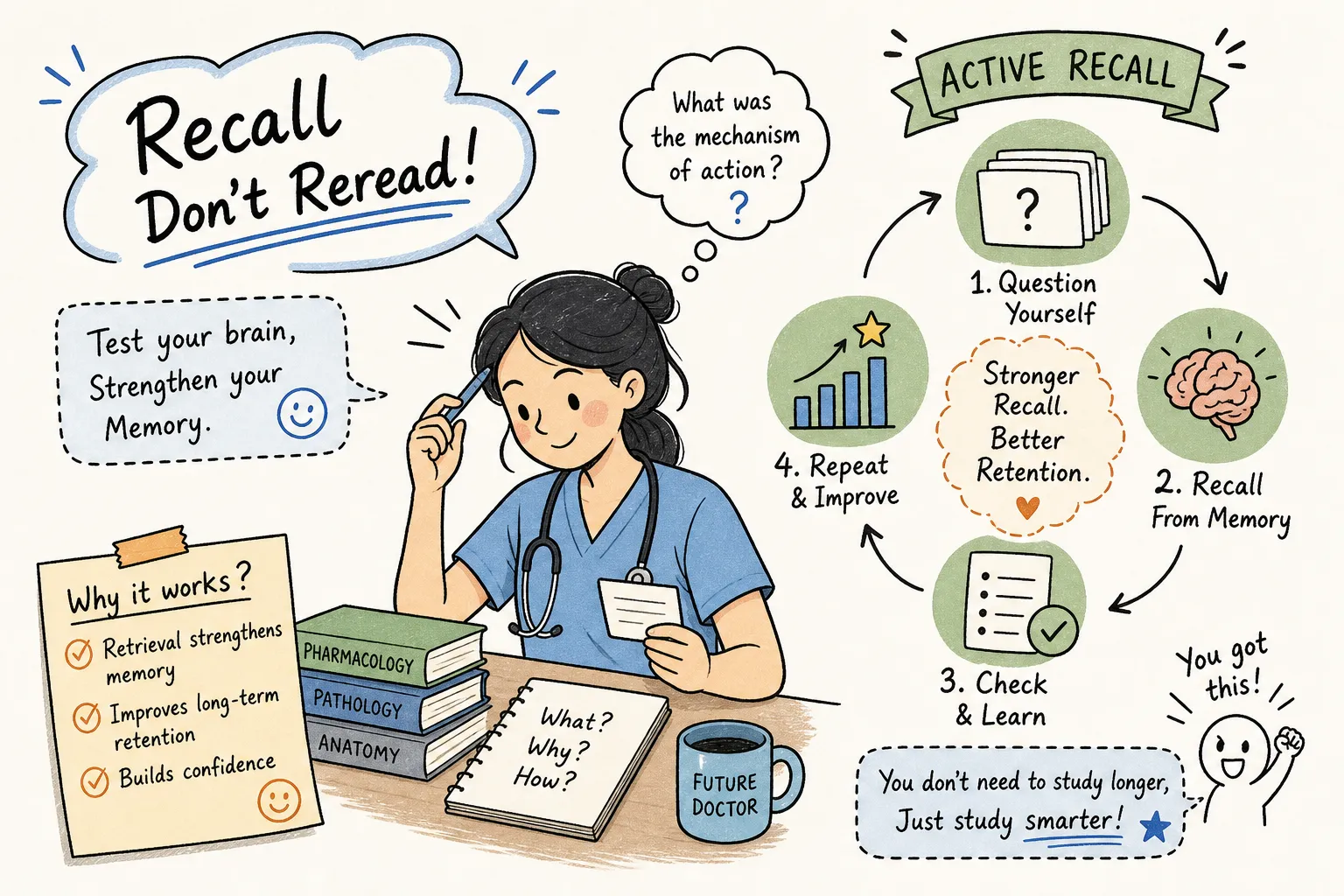
Active recall techniques for medical school work differently from passive review. Instead of exposing your brain to information and hoping it sticks, retrieval-based study forces you to pull information out of memory before you check whether you were right. That retrieval effort is the mechanism behind durable learning. The more often you practice retrieving something, the more reliably your brain stores and accesses it when the stakes are real.
This guide covers the cognitive science behind the approach, the core methods worth your time, how to match Anki card types to specific subjects, how to structure daily sessions so spaced repetition actually holds, the mistakes that silently sabotage retention, and how concept-based exam practice closes the gap between memorized facts and clinical reasoning.
Why Retrieval Effort Produces Retention Passive Reading Never Can
Every time you attempt to retrieve a memory, you strengthen the neural pathway to that piece of information. The harder the retrieval attempt, the stronger the encoding becomes. This phenomenon is called the testing effect, and it is one of the most consistently replicated findings in cognitive science. The effort is not a side effect of learning; it is the mechanism.
Re-reading produces the opposite. When you re-read your notes, the material feels familiar because you have seen it before. Your brain interprets that fluency as knowledge, but recognition is not recall. During an exam, you are not presented with your notes to recognize, you are asked to generate answers from memory under time pressure. The fluency built by re-reading does not transfer to that context.
The research on this is direct and consistent. Roediger and Karpicke (2006) randomized students to retrieval practice versus repeated study and found significantly better delayed retention in the retrieval group. Larsen et al. (2009) ran a randomized controlled trial specifically in medical education and confirmed the same pattern: repeated testing improved long-term retention compared to repeated study. Broad meta-analyses across health-professions education describe pooled effect sizes in the range of g = 0.50 to 0.61 favoring retrieval practice over rereading, with some medical-student subgroup analyses reaching g = 0.91 for active-learning strategies. These are not marginal differences. They represent a fundamentally more effective way to build the kind of memory that survives a 280-question exam.
Active Recall Techniques for Medical School: Core Retrieval Methods
Self-quizzing is the most immediate and accessible form of active recall. After reading a section or attending a lecture, close everything and write down what you remember. Do not check the source until you have made a genuine attempt to retrieve the material. This single habit reveals more about your actual retention in two minutes than a full hour of re-reading ever will.
Self-quizzing works best for new lecture material and end-of-day review. Use it as a diagnostic: if you struggle to recall the key points without prompting, that is useful information. It means the material is not yet encoded, and you need more retrieval practice before the next exam, not another read-through of your notes.
The Feynman technique adds a layer of understanding to retrieval practice. Pick a concept, explain it out loud as if you are teaching someone with no background in medicine, and keep going until your explanation breaks down. The breakdown point is the exact location of your knowledge gap, not a vague sense that you need to study more. Return to the source, fill the gap, and explain it again. This method is particularly powerful for physiology, pharmacology, and pathophysiology, where understanding the mechanism is what separates a student who can answer a vignette from one who can only recall a definition.
Practice questions are the highest-fidelity retrieval method for USMLE preparation. They force full context retrieval under timed, exam-like conditions. A useful and underused tactic is attempting questions before reviewing a topic rather than only after. An initial attempt, even a wrong one, primes the brain for deeper encoding when the explanation appears. Students who use questions only as a final self-test miss this priming effect entirely.
Anki Card Types Matched to What Each Subject Actually Demands
Cloze Deletion for Physiology and Pathology
Anki works because it applies spaced repetition automatically, scheduling cards based on how well you know them. But the benefit depends entirely on whether you are using the right card type for each subject. Using the wrong format is one of the most common and least recognized reasons Anki underperforms.
Cloze deletion cards are the best default for physiology and pathology. A cloze card deletes a key term from a sentence and asks you to fill it in during review. This format preserves the context of the mechanism rather than stripping it away, which matters when the relationship between concepts is what is being tested. A physiology card reading “Aldosterone acts on the [blank] to increase sodium reabsorption and potassium excretion” forces you to recall the nephron segment within its functional context. A stripped-down question-and-answer version of the same fact tests recognition far more than retrieval.
Image Occlusion for Anatomy
Image occlusion is the correct tool for anatomy. Spatial and visual information is tested by hiding labels on a real anatomical image, not by text-based prompts about named structures. Image occlusion forces recognition of structure, location, and spatial relationship simultaneously, which is much closer to how anatomy appears on practical exams and Step 1 than any text card can replicate.
Vignette-Style Cards for Clinical Reasoning
Clinical vignette cards deserve their own format: a brief patient scenario followed by a single question such as “what is the most likely diagnosis” or “what is the next best step.” Basic question-to-answer cards work well here because the goal is pattern recognition and clinical decision-making, not isolated fact retrieval. Cloze cards alone cannot build that reasoning layer. Vignette-style cards train the clinical thinking that drives Step 2 CK and shelf exam performance.
How to Structure Sessions So Spaced Repetition Actually Holds
The most common Anki failure mode is not a bad deck. It is a collapsed daily routine where reviews pile up, new cards keep being added, and the spaced repetition schedule becomes meaningless because nothing is reviewed at the right interval. The fix is a session structure that protects reviews above everything else.
A workable daily structure follows this sequence: clear all Anki reviews first thing in the morning before adding any new cards, tackle new material mid-day using active recall immediately after lecture, then spend the evening converting missed questions into targeted cards and running a short recall pass on weak topics. Keep active recall blocks focused and short. A 20-minute closed-book self-quiz or Feynman pass combined with 10 to 15 minutes of Anki reviews outperforms a two-hour passive re-read every time.
Card volume depends on where you are in training. Preclinical students can generally sustain 20 to 40 new cards per day within a 30 to 60 minute total session. Clinical-year students should drop to 10 to 20 new cards daily to keep the review load manageable alongside rotation demands. Protecting that ceiling is what keeps the schedule from collapsing.
Spacing intervals should reflect how well you know the material, not how recently you saw it. Weak items benefit from review at one to three days while the memory is still fragile. Medium-strength items hold better and can wait three to seven days. Strong items can extend to five or more days before the next review. Cramming violates this pattern because it masses repetitions together rather than spreading them. As Cepeda et al. and subsequent spacing research confirm, early reviews should be close together, then widen as the material consolidates.
Active Recall Mistakes That Silently Kill Your Retention
The most damaging mistake is confusing recognition with recall. This happens when you flip a card, read the question with the answer half-visible or half-remembered from a previous review, notice it looks familiar, and mark it correct. No real retrieval occurred. Almost no retention benefit was gained. The fix is behavioral: hide the answer completely, commit to a full retrieval attempt for at least 10 to 15 seconds, and say or write your answer before you reveal it. If you cannot do that, the card gets marked wrong.
Over-stuffed cards are the second major error. If a card takes more than 15 seconds to answer, it is testing multiple things at once and the retrieval is not clean. The brain does not know what it is being asked to strengthen. The fix is to rewrite broad cards into atomic units: one fact, one mechanism, or one decision point per card. Delete or suspend cards you are getting right through recognition rather than actual recall, and replace missed questions with new cards that target the specific misunderstanding, not just the surface answer.
Marking cards as correct when you guessed or recognized the answer is the fastest way to build false confidence. Be honest with the Anki grader. If you could not retrieve it cleanly, it goes back to the learning queue. That honesty is what keeps the spaced repetition schedule meaningful.
When Flashcards Are Not Enough: Concept-Based Exam Practice
Flashcards and self-quizzing build fact recall effectively. They do not, on their own, build clinical reasoning. USMLE questions require applying integrated concepts across organ systems, weighing competing diagnoses, and selecting the next best step in a patient scenario. A student can answer every Anki card on hyponatremia correctly and still miss a Step 2 CK vignette about it because the retrieval context is completely different. This is where most students plateau: their Anki performance looks strong, but their QBank scores do not reflect it.
Concept-based recall questions close that gap. Instead of testing whether you can retrieve an isolated definition, they build questions around the clinical logic of how a topic is actually tested on recent exams. The question forces you to apply knowledge to a scenario, reason through it, and select the correct answer without a labeled cue to anchor you. That is a meaningfully different cognitive demand than completing a cloze card, and it is what exam day actually requires.
RecallMastery has built its entire library around this approach. The platform provides concept-based, exam-reflective recall questions for USMLE Steps 1, 2, and 3 drawn from what has actually appeared on recent exams, updated monthly, and designed to complement a QBank workflow rather than duplicate it. For IMGs, retakers, and students pushing for a strong score on the first attempt, RecallMastery bridges the gap between fact memorization and real exam performance in a way that flashcard decks alone cannot.
Putting It All Together
The hierarchy of active recall techniques for medical school looks like this: self-quizzing and the Feynman technique for immediate same-day recall, Anki with subject-appropriate card types for systematic spaced review over time, practice questions for exam-context retrieval under timed pressure, and concept-based recall questions for the clinical reasoning layer that separates high scorers from the rest. Each method serves a different function. Using all of them together covers the full range of what USMLE preparation actually demands.
The behavioral shift that makes all of this work is straightforward: close your notes and retrieve instead of re-read. That single decision, repeated across every study session, trains your memory the way the brain actually learns. The discomfort of not knowing is not a sign that you are failing. It is the signal that encoding is happening.
Start with self-quizzing at the end of today’s lecture material, five minutes is enough to expose where the gaps actually are. Track your practice question performance over the next week and watch what changes. Applying even one active recall technique for medical school consistently will produce measurable gains in retention and exam readiness. The goal is not to feel prepared. The goal is to actually be prepared when the test starts.
Study from what the exam is actually testing
RecallMastery’s USMLE Step 1 recalls are concept-based, updated monthly through your test date, and delivered as a single file you can open on any device. Also worth a look: free recall samples.
Related reading
- The Most Repeated USMLE Step 1 Concepts You Must Know
- Active Recall Strategies to Ace USMLE Step 1
- The Ultimate Spaced Repetition Guide for USMLE Step 1
- How to Prepare for the USMLE: A Step-by-Step Overview
- What to Do Differently If You Failed USMLE Step 1
- How to Actually Retain Pathoma and First Aid