

Written and reviewed by doctors and medical students who have recently sat these exams. Last verified 13 August 2026.
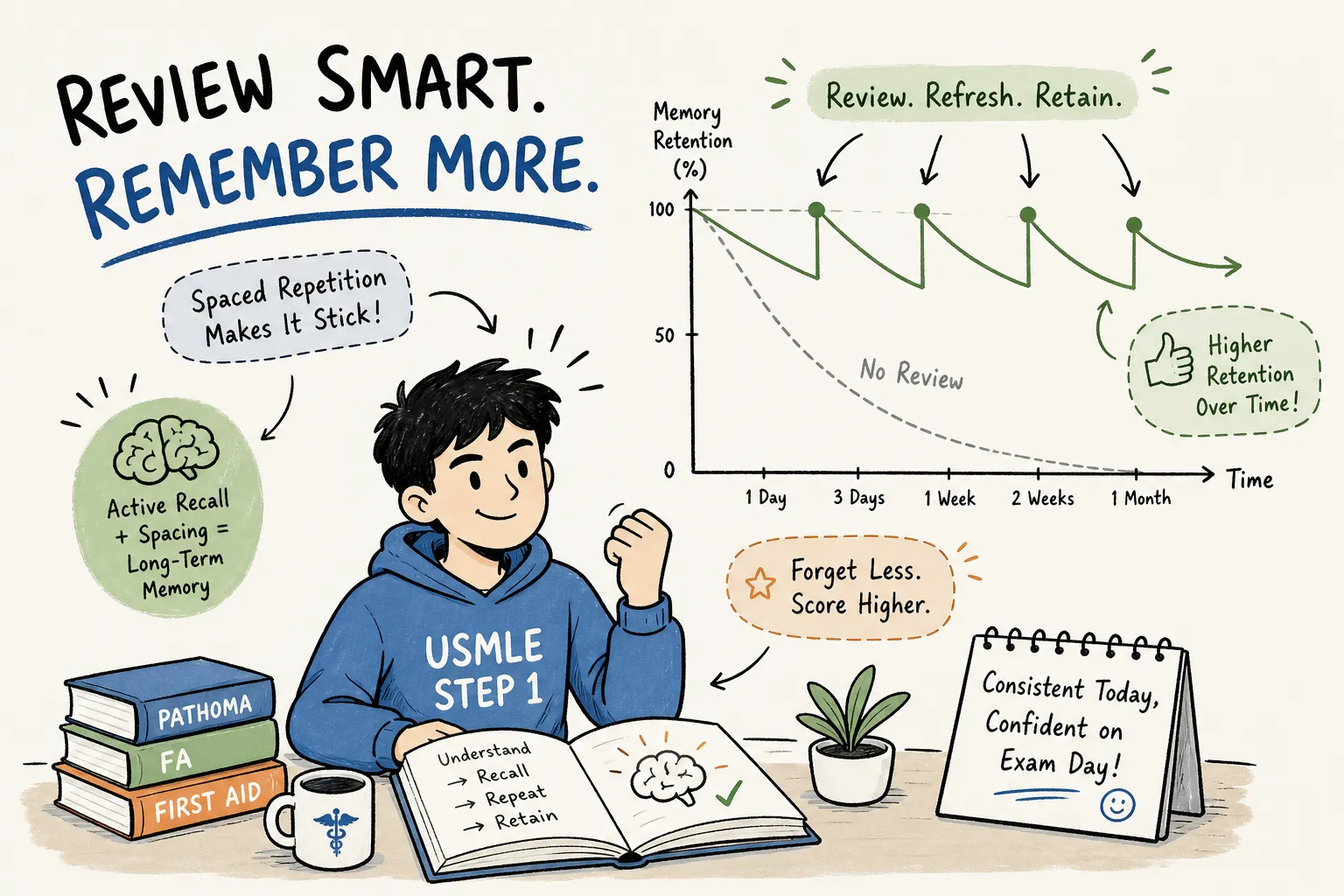
You already know spaced repetition works. The research is clear, the testimonials are everywhere, and you downloaded the AnKing deck months ago. But somewhere between your first 40-card day and today, Anki became the thing you dread opening. The due count climbed. You skipped a weekend. Now the backlog looks like a wall, and you’re not sure whether to bulldoze through it or start over. What you’re missing isn’t motivation, it’s a real spaced repetition schedule for USMLE Step 1: specific daily targets, settings you configure once and leave alone, and a rhythm that integrates with your UWorld blocks and NBME checkpoints.
The problem isn’t Anki. The problem is that “do Anki every day” is not a schedule. It’s a wish. What actually works is a structured Step 1 spaced repetition plan with clear volume targets and a system that bends around your study calendar rather than competing with it. This article gives you the complete framework: how to pick your pace, configure your settings, build a daily workflow, and wind down cleanly in the final two weeks.
Why most Anki schedules break down before Step 1
The backlog spiral explained
Adding new cards faster than your review capacity can absorb them creates compounding debt. At 80 new cards per day, you’re not just adding 80 reviews for tomorrow, you’re scheduling reviews for the next several weeks simultaneously. Within days, your due count balloons. At the standard 10, 15 seconds per card, 500 due cards will consume 80, 125 minutes of reviews before you’ve touched a single UWorld block. Many students respond by skipping sessions, which makes the next session worse. That’s the spiral.
Why the schedule matters more than the deck
AnKing and Zanki are widely used, comprehensive decks, but they don’t organize themselves. The sequencing and volume decisions you make in week one determine whether spaced repetition actually spaces your learning or just stacks review debt. The deck is the content; the schedule is the engine.
Building your spaced repetition schedule for USMLE Step 1 by timeline
The 3/6/12-week card volume breakdown
Your timeline determines everything about your daily targets. If you’re 12 weeks out, aim for 20, 40 new cards per day with 150, 250 daily reviews. At 6 weeks, shift to 30, 60 new cards and 200, 400 reviews. At 3 weeks out, you’re looking at 50, 100+ new cards with 300, 500+ daily reviews, and at that pace, reviews alone will run 1.5, 2 hours before any other studying. Starting earlier is generally the lower-stress path, because the review load you build in week one compounds for the rest of your dedicated period.
How to calculate your daily time commitment
The formula is straightforward: multiply your expected daily reviews by 12 seconds to get a baseline estimate in seconds, then divide by 60 for minutes. At 400 reviews, that’s roughly 80 minutes of Anki at a clean pace. In reality, complex cards slow you down, so budget 90, 120 minutes for 400 reviews. Many students completing UWorld blocks and reading explanations report that 400 reviews per day is a practical ceiling. If your projected review count climbs above that, lower new cards, not the review cap.
When to suspend new cards entirely
Plan your stop date before you start. The consensus across top Step 1 guides is to stop creating new cards 10, 14 days before your exam. Any card you add in that window won’t have time to mature before test day, and chasing new material in the final stretch increases anxiety without meaningfully improving your score. Build that cutoff into your calendar now, so you’re not making the decision under pressure.
The Anki settings that actually help you retain more
The settings that matter most (and the ones that don’t)
Set maximum reviews per day to 9999. This is not a typo. Anki’s default review cap silently defers cards you actually need to see, creating a hidden backlog that surfaces later as a crisis. If your review load feels unmanageable, the correct fix is reducing new cards per day, not capping reviews. Set your leech threshold at 8 lapses. Any card that fails 8 times is more often a poorly written card than a concept you’re incapable of learning.
FSRS vs. SM-2: which one to use for Step 1
FSRS is the better choice for most students starting fresh in 2026. Unlike SM-2, which applies a fixed algorithm, FSRS adapts to your actual memory performance over time. For AnKing V12, use FSRS with desired retention set to 0.90, learning steps of 1m then 10m, short same-day relearning steps, and maximum interval set high (36,500 days) so the algorithm controls spacing rather than an artificial ceiling. If you’re deep into an SM-2 setup and don’t want to switch, the community-standard settings are: learning steps of 15m, 1 day, 3 days; graduating interval of 8 days; and the same 9999 review cap.
What to do with leeches instead of suspending them
Suspension is a last resort. When a card hits 8 lapses, read it critically first. Most leeches fail because they test two concepts at once, use an ambiguous cue, or pack the answer with so much text that there’s no clear focal point. Rewrite it as two atomic cards, one fact per card, and the leech problem usually disappears. Suspend only when the content is genuinely low-yield or appears nowhere in your UWorld weak areas.
Building your daily workflow around Anki and UWorld
The daily sequence that keeps both systems moving
Do Anki reviews first, every morning, before you add any new information to your brain. Reviews are retrieval practice on what you already know; doing them first primes recall pathways before UWorld adds new material. Run one UWorld block midday in timed or tutor mode, depending on where you are in your plan. Review that block immediately and thoroughly: read the educational objective, understand why you missed what you missed, and create cards only from your highest-yield gaps. Don’t defer block review to the next day. Anki retains; UWorld teaches. Reversing those roles dilutes both.
How to shift priorities using NBME results
Use NBME self-assessments as recalibration checkpoints, not just score checks. A baseline at week one, then reassessments every 1, 2 weeks, with your final NBME roughly 7, 10 days before your exam gives you enough data to act on. If a system-level weakness appears, increase Anki cards and UWorld questions in that area for the next two weeks. If the weakness is reasoning-based rather than factual, pull back on new card creation and add more timed mixed blocks instead. The right coverage-to-remediation ratio shifts as your exam approaches: 70/30 at 12 weeks, 50/50 at 8 weeks, and 20/80 at 4 weeks.
Closing out the final two weeks without falling apart
The two-week tapering schedule
Stop creating new cards at day 14 before your exam. From day 14 to day 7, run daily reviews plus UWorld targeting your documented weak areas. From day 7 to day 3, shift to review-only and NBME question analysis: no new card creation, no new resources, just integration of what you’ve already learned. On day 2 and day 1, keep studying light. Do a final pass of flagged or starred cards, prioritize sleep, and stop adding anything. The final two weeks are about retrieval, not acquisition.
How to handle a backlog in the final stretch
If you hit the last two weeks with a pile of overdue reviews, don’t panic and don’t try to catch every card. Sort by relative overdueness and prioritize cards that have already matured over newer ones. A matured card, one successfully retrieved multiple times at increasing intervals, leaves a retrievable trace in memory even if it went overdue. Chasing every single overdue card in the final week costs you sleep and introduces anxiety that degrades performance more than any missed review ever could. Accept the imperfect deck. You’re not finishing Anki. You’re passing Step 1.
Start with a schedule, not a deck
A spaced repetition schedule for USMLE Step 1 isn’t about perfecting your settings or clearing every card. It’s about choosing a sustainable daily pace and knowing exactly when to stop adding and start consolidating. Most students who struggle with Anki don’t have a deck problem. They have a planning problem.
Pick your timeline today. Set FSRS to 0.90 retention, cap new cards to a number you can sustain alongside UWorld, set the review limit to 9999, and block your card-creation cutoff in your calendar right now.
Related reading
- Active Recall Strategies to Ace USMLE Step 1
- Active Recall Techniques Every Med Student Needs
- What to Do Differently If You Failed USMLE Step 1
- How to Actually Retain Pathoma and First Aid