

Written and reviewed by doctors and medical students who have recently sat these exams. Last verified 1 september 2026. How we source and verify recall content.
Many students preparing for Step 1 lean heavily on passive methods, re-reading First Aid, skimming UWorld explanations, highlighting pages of notes, then wonder why nothing sticks on test day. The problem isn’t effort. It’s direction. Active recall strategies for USMLE Step 1 flip the entire approach: instead of pushing information in, you force your brain to pull it out. That retrieval effort is what builds durable memory, and it’s exactly what Step 1 tests.
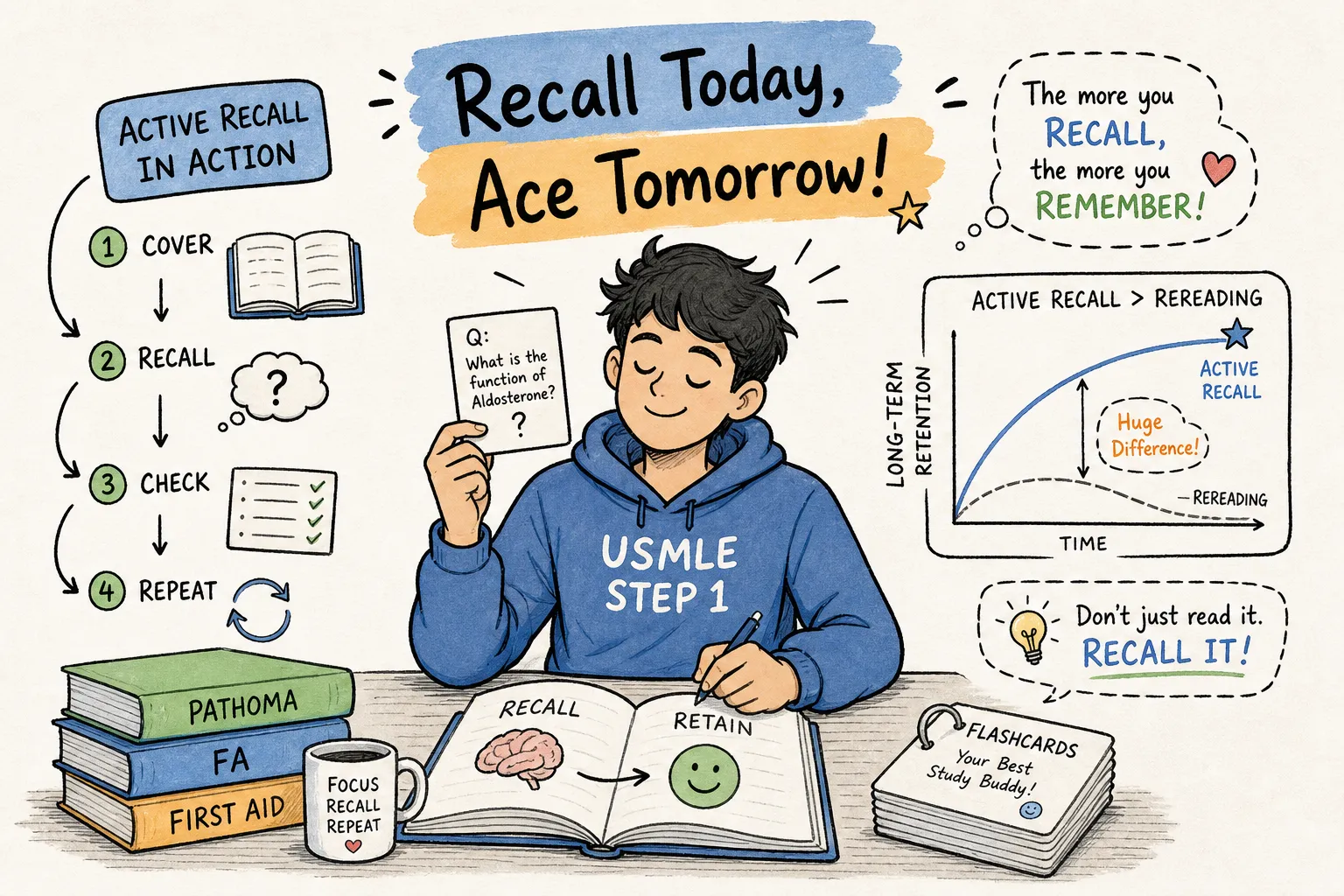
The cognitive science here is clear. A 2006 study by Roediger and Karpicke found that practice testing ranked among the most effective learning techniques available, by contrast, rereading ranked among the least effective. That research confirmed repeated retrieval led to significantly higher long-term retention than repeated studying, with the advantage growing larger on delayed tests. Step 1 is a delayed test by definition. Everything you study today needs to be retrievable weeks or months from now, under pressure, inside an unfamiliar clinical vignette. That’s the bar, and passive review doesn’t clear it.
This article walks through six concrete techniques, an Anki setup that actually works, a UWorld workflow built around retrieval, and schedules for both preclinical years and dedicated study. It also covers how RecallMastery is built from the ground up around this principle, giving students access to Step 1 recall files that reflect what’s currently being tested on real exams.
Why passive study fails Step 1 and active recall doesn’t
The testing effect is not a study tip. It’s a fundamental property of how human memory works. Every time you successfully retrieve a piece of information from memory, that memory trace gets stronger and more retrievable in the future. Every time you simply re-expose yourself to the same information, you reinforce recognition without building retrieval. Step 1 is not a recognition exam. It presents novel clinical vignettes that require you to generate reasoning under time pressure, not identify something you’ve seen before.
Students who rely on passive re-exposure often plateau on UWorld. They recognize answer explanations without being able to generate the reasoning independently when the vignette shifts slightly. The performance gap between students who train retrieval and students who train recognition becomes most visible during the dedicated phase, when question difficulty increases and familiar explanations stop being enough. Switching to active self-testing is one of the highest-leverage changes a plateaued student can make. The goal isn’t to study more hours; it’s to spend those hours in retrieval mode.
Active recall strategies for USMLE Step 1: six core techniques
Practice question-first studying: work the problem before you read
This is the most powerful reframe in Step 1 prep. The standard approach is to read a topic, watch a video, then do questions to check comprehension. Flip the sequence entirely: attempt questions on the next concept before opening First Aid or watching any lecture. Pull a UWorld block first, struggle through it, identify exactly where your knowledge breaks down, then study the explanation as a targeted correction to a specific gap. That gap-finding process is itself a retrieval event, and it transforms passive review into active learning.
Retrieval and corrective feedback strengthen memory traces more effectively than simply absorbing new content, trying and failing to recall something primes your memory for the correct answer in a way that reading alone never does. Implement this during your next study session: set the topic for the day, pull a 10-question UWorld block on it cold, then open your resource.
Elaborative interrogation: ask “why” before you move on
Elaborative interrogation means asking yourself why a fact is true, not just accepting it. In Step 1 terms, instead of memorizing that statins can cause myopathy, ask why. What is the mechanism? What does it share with other drugs that cause myopathy? What would the vignette look like, and what lab value would confirm it? This forces conceptual integration rather than isolated fact storage, which maps directly to how Step 1 vignettes are constructed. Boards don’t ask you to recall facts; they embed facts in clinical scenarios that require you to reason from mechanism to presentation to management.
Apply this technique during your UWorld review by asking one “why” question per wrong answer before moving on. A strong answer for a beta-blocker question, for example, traces the receptor to the physiological effect to the clinical consequence. That causal chain is what Step 1 actually tests.
Self-explanation after every question block
After a timed UWorld block, don’t open the answer explanations immediately. Close the screen and explain each missed concept out loud or in writing from what you already know. This two-to-three-sentence spoken or written explanation surfaces gaps that rereading misses entirely, because rereading creates familiarity without confirming that you can actually generate the reasoning yourself. When combined with retrieval practice, the gains compound. Medical education research, including reviews on self-explanation as a learning strategy, consistently shows this approach outperforms passive restudy for long-term retention. Self-explanation before re-exposure is one of the highest-value habits you can build in dedicated study.
Anki workflow for Step 1 active recall: settings and card types that work
Choosing the right card types and settings for Step 1
Three card types serve distinct purposes in a Step 1 Anki deck. Cloze deletions handle high-yield facts efficiently; they’re the workhorse format for the AnKing deck and the fastest way to process large amounts of board-relevant content. Basic Q&A cards are better for concept-heavy misses that need deeper active recall, particularly custom cards built from UWorld errors. Image occlusion is the right format for anatomy and histology, turning labeled diagrams into retrieval prompts instead of visual references.
For scheduling in 2026, FSRS is the superior choice over the older SM2 algorithm. FSRS personalizes intervals to your actual review history and typically reduces total review volume by 20 to 30 percent at comparable retention rates. That matters enormously when you’re managing thousands of cards across months of dedicated study. Community Anki guides for Step 1 prep commonly recommend a retention target around 0.90; pair that setting with the AnKing Step 1 deck (suspended by default, unsuspended by topic as you study) and aim for 30 to 60 new cards per day in preclinical years, shifting toward review-heavy workloads as your test date approaches.
Converting missed questions into custom cards that stick
The habit of building Anki cards from UWorld misses separates students who plateau from students who keep improving. The rule for card structure is atomic: one fact, one rule, or one distinction per card. Cards that try to encode an entire pharmacology pathway on one side become leeches that you suspend instead of fix. When a card crosses your leech threshold (around eight to ten lapses), don’t keep pressing on it. Refactor it into two simpler cards, each testing one component of the original concept.
Write prompts in retrieval format, not fill-in-the-blank format. “What distinguishes X from Y on presentation?” forces generation. “X causes ___” invites pattern-matching without real retrieval. After your next wrong answer, write one card in your own words before closing UWorld, add it to your queue, and retest it closed-book the following day. That sequence, attempt, diagnose, compress, schedule, retest, is the foundation of the top-scorer workflow.
How to turn every UWorld block into a retrieval session
The attempt-diagnose-compress-retest workflow converts each UWorld question from a right/wrong checkpoint into a retrieval event. Read the stem fully and form your own answer before looking at the choices. Commit to reasoning, not elimination. After the block, review explanations even for correct answers, because correct answers can hide weak reasoning. Then isolate the specific concept missed: not the whole question, but the one mechanism, pattern, or rule that caused the error. Convert that gap into a single narrow recall prompt in your own words, add it to your spaced-repetition queue, and retest it closed-book.
On daily question volume: 40 to 60 questions per day suits recovery or pass-focused study; 60 to 80 per day is the sustainable range for solid preparation; 80 to 120 per day is realistic for students targeting high scores, assuming timed random blocks and genuine review of every miss. Volume without review quality creates shallow repetition. In practice, UWorld percent correct predicts Step 1 performance more reliably than raw question count alone. Sixty to eighty questions with thorough review beats 120 questions with a quick skim of explanations, every time.
Scheduling active recall for USMLE Step 1: preclinical years vs. dedicated study
What a preclinical active recall day looks like
In preclinical years, the structure is short and frequent. Start mornings with Anki reviews before any new content. After each lecture or topic, spend 10 to 15 minutes converting what you just learned into questions or self-test prompts while the material is fresh. End the evening with a brief blank-page recall dump: write everything you remember about the day’s topic without looking at notes, then check gaps. This phase is about content-building, turning lectures into durable memory units that won’t need to be relearned during dedicated study. One weekly consolidation session for older material that’s starting to fade rounds out the cycle.
How dedicated study changes the rhythm entirely
Dedicated Step 1 study shifts the goal from content-building to performance-building. Mornings anchor on Anki reviews: 200 to 300 due cards before new work. Midday is for timed UWorld blocks with the full retrieval workflow described above. Evenings are for error review and card creation from misses. Weekly, a comprehensive sweep of recurring weak areas and high-yield misses keeps the cumulative picture sharp. The key difference from preclinical years is that every session now simulates the conditions of the actual exam: timed, high-pressure, mixed-topic retrieval. You’re not studying to understand; you’re training to perform.
How RecallMastery puts active recall to work at exam scale
Most study resources hand you passive content and expect you to build your own retrieval practice from scratch. RecallMastery works differently. Its Step 1 recall files are structured around questions that reflect what is currently being tested on real exams, meaning the active recall mechanism is embedded in the material itself. Students aren’t working through a static reference; they’re engaging with content that forces retrieval at every step, built on the same principle the research supports: generating answers from memory builds durable knowledge, while recognizing answers from a highlighted page does not.
Active recall only works if the material you’re retrieving is current. RecallMastery’s recall files are updated monthly through each student’s test date, keeping retrieval practice aligned with recent exam content rather than question patterns from prior years. For IMGs, retakers, and dedicated-phase students who can’t afford to work from outdated material, that update cycle means the retrieval practice stays relevant to what Step 1 is actually testing. The single-file digital format means you’re working from one clean resource instead of juggling multiple decks, notes, and supplementary PDFs across devices.
Start with one technique and build from there
Active recall isn’t a study hack. It’s the mechanism by which durable medical knowledge is actually built. The students who score well on Step 1 aren’t studying more hours; they’re spending those hours forcing retrieval, correcting gaps, and spacing their practice so that recall becomes automatic by test day. The cognitive science is consistent, the workflows are well-defined, and the results compound over time.
Pick one active recall strategy for USMLE Step 1 from this article and put it to work today. Try question-first studying before your next topic, or run a self-explanation session after your next UWorld block before reading the answers. Build the habit before adding complexity. If you’d rather spend that time retrieving than building infrastructure from scratch, RecallMastery’s recall files put active retrieval to work immediately, exam-current content updated monthly through your test date, no setup required. The mechanism is already built in. You just have to show up and retrieve.
Study from what the exam is actually testing
RecallMastery’s USMLE Step 1 recalls are concept-based, updated monthly through your test date, and delivered as a single file you can open on any device. Also worth a look: free recall samples.
Related reading
- The Most Repeated USMLE Step 1 Concepts You Must Know
- Active Recall Techniques Every Med Student Needs
- The Ultimate Spaced Repetition Guide for USMLE Step 1
- How to Prepare for the USMLE: A Step-by-Step Overview
- What to Do Differently If You Failed USMLE Step 1
- How to Actually Retain Pathoma and First Aid