

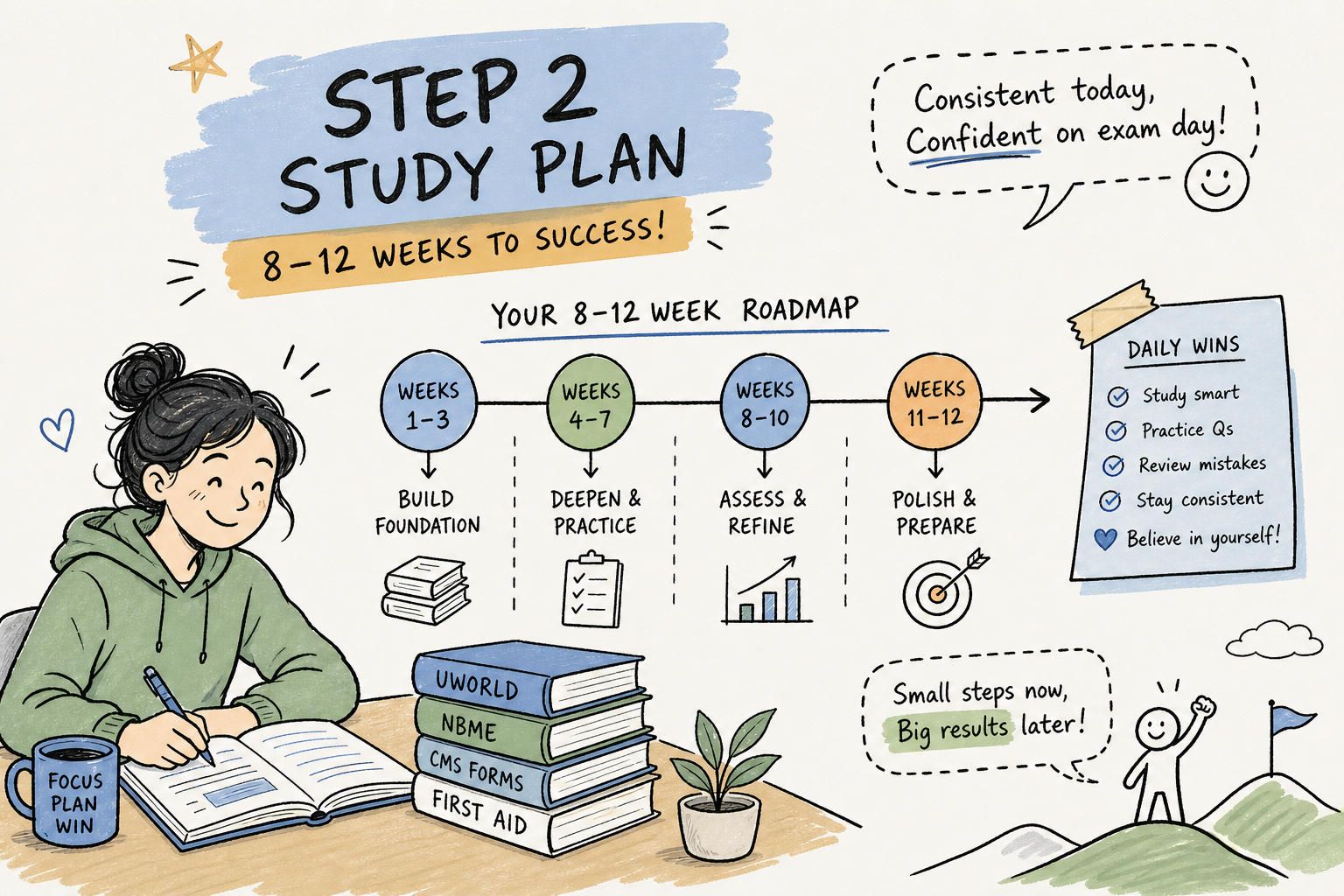
USMLE does not set a required study time for Step 2 CK. How long you need depends on your starting point, which an NBME practice test after your first week can show. A good schedule moves from system review to timed mixed blocks to final review. Below is our suggested week-by-week 8-week plan, plus 4-, 6- and 12-week versions.
Written by Derek Nicolas, medical student. Facts checked against usmle.org and nbme.org on 12 November 2026.
What Step 2 CK facts do you need before you plan?
These official facts shape every plan on this page. Each one links to its source.
| Question | Answer |
|---|---|
| What is the test format? | For exams on or after 7 May 2026: one day, one 9-hour session, sixteen 30-minute blocks, with no more than 20 questions per block (usmle.org: Step 2 CK). Up to 318 questions in total (usmle.org: Exam Resources). |
| How much break time is there? | At least 55 minutes of break time and a 5-minute optional tutorial. If you finish a block early, the time left is added to your break time (usmle.org). |
| Can you go back to an earlier block? | No. You can review questions only inside the block you are in. Once a block is closed, you cannot return to it (USMLE software announcement). |
| What is the passing score? | 218, for exams on or after 1 July 2025. Scores are on a three-digit scale (usmle.org: Examination Results and Scoring). |
| When do scores come out? | Usually within four weeks of your test date. USMLE says to allow at least eight weeks when you choose your test date (usmle.org). |
| Can you retake it to raise your score? | No. You may not retake a Step you passed to raise your score. You have four attempts per Step (usmle.org: Common Questions). |
| Where do you take it? | At Prometric test centers (usmle.org). |
| What official practice is there? | More than 100 free sample questions from USMLE, as a PDF and as an interactive test (usmle.org: sample questions). NBME also sells the Comprehensive Clinical Science Self-Assessment (CCSSA): seven forms, price starts at $62 (nbme.org: CCSSA). |
What does Step 2 CK cover?
USMLE’s Step 2 CK content outline gives the share of questions for each area. Medicine is the largest discipline, so our plan starts there. Many questions count in more than one discipline, so the totals add up to more than 100%. USMLE says the percentages can change at any time.
| Discipline | Share of questions |
|---|---|
| Medicine | 55–65% |
| Pediatrics | 17–27% |
| Obstetrics and gynecology | 10–20% |
| Psychiatry | 10–15% |
| Surgery | 5–15% |
| System or topic | Share of questions |
|---|---|
| Nutrition (each nutrition question also counts in one of the systems below) | 15–20% |
| Social sciences: legal and ethical issues, professionalism, systems-based practice and patient safety | 10–15% |
| Renal and urinary system and reproductive systems | 7–13% |
| Cardiovascular system | 6–12% |
| Musculoskeletal system, skin and subcutaneous tissue | 6–12% |
| Behavioral health | 5–10% |
| Blood and lymphoreticular and immune systems | 5–10% |
| Gastrointestinal system | 5–10% |
| Nervous system and special senses | 5–10% |
| Respiratory system | 5–10% |
| Multisystem processes and disorders | 4–8% |
| Endocrine system | 3–7% |
| Pregnancy, childbirth and the puerperium | 3–7% |
| Biostatistics, epidemiology, population health and reading medical studies | 3–5% |
| Human development (normal age-related findings and care of the well patient) | 2–4% |
By physician task, the largest shares in the same outline are diagnosis (16–20%), laboratory and diagnostic studies (13–17%), mixed management (12–16%) and pharmacotherapy (8–12%). So when you review a question, learn the next step in care, not only the diagnosis.
USMLE added more nutrition content to all Step exams from June 2026. It also says you should not change how you study because of this (USMLE nutrition announcement).
How long should you study for Step 2 CK?
There is no official answer. In our view, three things decide it: your first NBME score report, how long ago you finished your core clerkships, and whether you are still on rotations or working. The length also sets how hard each day is. A shorter plan needs more questions every day.
An NBME CCSSA score report shows your likely score range next to the Step 2 CK “low-pass range”, which means scores just above the passing standard. NBME says any overlap between the two is a reason for extra caution (NBME readiness guide). We use this to suggest a length:
- 4 weeks: you finished core clerkships recently, you did much of a question bank during rotations, and your first likely score range is completely above the low-pass range.
- 6 weeks: the same, but you have a few weak systems or less question-bank work behind you.
- 8 weeks: our default plan. It gives you a system review and then a timed, mixed practice phase. Choose it if you are not sure.
- 10 to 12 weeks: you finished core clerkships more than six months ago, your likely score range overlaps or is below the low-pass range, or you can only study part time. A longer plan is not a sign of weakness. It lets you study at a pace you can keep.
Your goal score matters too. If you aim well above the passing score of 218, choose the longer option when you are between two.
What does our 8-week Step 2 CK schedule look like?
This is our suggested plan, not an official one. It assumes 8 to 10 hours of study a day, 6 days a week. Use the seventh day to rest, or use half of it to catch up. Practice in 20-question, 30-minute blocks. Since 7 May 2026, Step 2 CK blocks are 30 minutes with up to 20 questions, so a full block gives you 90 seconds per question.
| Week | Focus | Daily question-bank target | Review and other tasks | Self-assessment |
|---|---|---|---|---|
| 1 | Set up your routine. Cardiovascular and respiratory systems. | 40–60 questions (2–3 blocks of 20), tutor mode, by system | Read every explanation. Start an error log. Try the new Step 2 CK interactive test on usmle.org once to learn the software. | CCSSA form 1 at the end of the week (your baseline). Then confirm or change your test date. |
| 2 | Gastrointestinal, endocrine, renal and urinary systems. | 60–80, tutor mode or timed, by system | Review every CCSSA 1 explanation. Add its weakest areas to your midday slots. Make flashcards only from missed questions. | None |
| 3 | Reproductive systems, pregnancy and childbirth (obstetrics and gynecology), and pediatrics topics such as growth and well-child care. | 60–80, timed, by system | Do a few ethics and patient safety questions every day. Go through your error log at the weekend. | CCSSA form 2 at the end of the week |
| 4 | Nervous system, behavioral health (psychiatry), musculoskeletal system and skin. Start timed mixed blocks mid-week. | 80–100 (4–5 blocks of 20), timed | Midday: content review for these systems. At the weekend, check your question-bank results by system and pick your 2 or 3 weakest. | None |
| 5 | Blood, lymph and immune systems, multisystem disorders, biostatistics and epidemiology. Timed mixed blocks every day. | 80–100, timed, mixed | Midday: your weakest systems from CCSSA 2. Start redoing incorrect and flagged questions. | CCSSA form 3 at the end of the week |
| 6 | Weak areas from CCSSA 3. Management and “next step” questions. | 80–100, timed, mixed | One full practice day: about 8 hours of timed 20-question blocks with breaks, like test day. Review it over the next two days. | None |
| 7 | Second pass: incorrect and flagged questions, then the largest areas again. | 60–80, timed, mixed, plus redone incorrect questions | No new resources. No new flashcards; review the ones you have. | CCSSA form 4, about a week before your exam |
| 8 | Light review and rest. | 40–60 in the first days; few or none on the last day | Plan your test day: route, ID, food and break plan. Keep your normal sleep times. | Free 120 (official sample questions), 3 to 5 days before the exam |
At these targets you will do about 3,000 to 4,000 questions in 8 weeks. Check this against the size of your question bank. If you cannot finish the bank, review well instead of rushing to the end.
What are the three phases of the plan?
- Weeks 1 to 3, build the base: the goal is to fill gaps, not to prove what you know. Use tutor mode at first so you read explanations as you go. Keep the number of questions moderate and leave time for content review. Do not start with timed mixed blocks on day one.
- Weeks 4 to 6, practice like the exam: move to timed, mixed blocks. Each week, find your weakest systems and give them extra review time. Your middle CCSSA shows whether the plan is working.
- Weeks 7 and 8, polish: build stamina and go over what you got wrong. Do not add new content or new resources. Do not change your whole plan because of one practice score.
When should you take NBME self-assessments and the Free 120?
The NBME Comprehensive Clinical Science Self-Assessment (CCSSA) is NBME’s practice test for Step 2 CK. NBME lists seven forms. Each form has four sections of 50 questions. The standard-paced option allows 1 hour 15 minutes per section; the self-paced option allows 5 hours per section. After the test you can read answer explanations for every question and see your results by content area.
NBME’s readiness guide explains the score report:
- Total score: on the same 1–300 scale as Step 2 CK. It estimates your Step 2 CK score with the same knowledge and test conditions.
- Likely score range: if you tested again without learning or forgetting anything, your score would be within 8 points of the reported score two-thirds of the time.
- Estimated probability of passing Step 2 CK within a week: from 1% to 99%. It comes from a model based on a large group of examinees who took Step 2 CK for the first time within one week after the self-assessment.
The same guide says the estimate is not a guarantee: a 90% chance of passing still means 1 in 10 students with that performance will fail. It also says:
- if you take the CCSSA more than a week before Step 2 CK, your chance of passing may be different, because you may learn or forget more before the exam;
- the results are less reliable if you use self-paced timing, look at notes while testing, or take the same form more than once.
Our advice: take every form in one sitting, standard-paced, with no notes, and never take the same form twice. Take your baseline after one week of study, not before. In our view, a week of work gives a more useful starting score than a cold test. In the 8-week plan, space the forms about two weeks apart (closer together in a 4-week plan). Leave at least a day to review each one. Take the last form about a week before your exam, because that is the timing NBME’s estimate is built on.
Some question-bank companies also sell their own practice tests. You can use them for extra practice. Our plan uses NBME forms because NBME publishes how its score relates to passing Step 2 CK.
Where does the Free 120 fit?
USMLE gives free Step 2 CK sample questions as a PDF and as an interactive test (usmle.org). The PDF booklet has 120 questions in three blocks of 40, the set students call the “Free 120” (official booklet). The booklet says most of its questions are the same as those on the USMLE website, and that reading them on paper is not a substitute for practice on the website. For exams on or after 7 May 2026, USMLE says to use the new interactive test so you get used to the 30-minute blocks.
- Week 1: try the new interactive test once to learn the software.
- Week 8, 3 to 5 days before your exam: do the full set, timed, with no notes. Use it for practice and to feel the screen, not as a score prediction.
- After you finish: check your answers with the key, then read our explanations for Block 1, Block 2 and Block 3. All three are listed on our Free 120 explanations page.
If the test center makes you nervous, USMLE lets registered examinees take a practice session at a Prometric test center for a fee (usmle.org). NBME says you can book it only after you receive your USMLE registration permit. It uses the same sample test materials as the USMLE website and is shorter than Step 2 CK itself. It gives only limited feedback: your percent correct in each block (nbme.org).
What does a good Step 2 CK study day look like?
Here is our suggested day for weeks 4 to 6 of the 8-week plan:
- Morning, about 3 hours: two timed 20-question blocks, then review them. Do questions first while you are fresh, and keep flashcards for later in the day.
- Midday, about 2 hours: content review of the topics you missed, from one book or video resource.
- Afternoon, about 3 hours: two or three more timed blocks, each followed by review.
- Evening, 30 to 45 minutes: flashcards made from your missed questions. Then stop at a set time and protect your sleep.
How should you review questions?
- Read every explanation: for wrong answers, for guesses and for correct answers.
- Spend at least as much time reviewing as answering. We would rather you do 80 questions and review them well than do 120 and skim them.
- Keep an error log. For each miss, write the topic, why you missed it (did not know it, misread it, or changed a right answer) and the rule in one line.
- Look for patterns in your wrong answers, not just single facts.
- For each question, ask “what is the next step?” as well as “what is the diagnosis?”.
- Once a week, check your question-bank results by system and move your 2 or 3 weakest systems into next week’s midday slots.
What are the 4-, 6- and 12-week versions?
These use the same phases and the same daily routine as the 8-week plan. Only the length of each phase changes.
| Part of the plan | 4 weeks | 6 weeks | 12 weeks |
|---|---|---|---|
| System review | Week 1, largest systems only, timed | Weeks 1–2 | Weeks 1–5 |
| Timed mixed blocks | Weeks 2–3 | Weeks 3–5 | Weeks 6–10 |
| Final review and rest | Week 4 | Week 6 | Weeks 11–12 |
| Daily question-bank target | 80–100 in weeks 1–3 (up to 100–120 in week 3 if your review time allows); 40–60 in week 4 | 40–60 in week 1, 60–80 in week 2, 80–100 in weeks 3–5; 40–60 in week 6 | 40–60 in weeks 1–2, 60–80 in weeks 3–5, 80–100 in weeks 6–10; 60–80 in week 11, 40–60 in week 12 |
| CCSSA forms | End of weeks 1, 2 and 3 | End of weeks 1, 3 and 5 | End of weeks 1, 4, 7, 9 and 11 |
| Free 120 | Week 4, 3 to 5 days before the exam | Week 6, 3 to 5 days before the exam | Week 12, 3 to 5 days before the exam |
In every version, the last CCSSA comes about a week before the exam, and the daily target drops in the last week. For a 10-week plan, adapt the 12-week column:
- System review in weeks 1–4, timed mixed blocks in weeks 5–8, final review in weeks 9–10.
- Build from 40–60 to 80–100 questions a day, then drop to 40–60 in week 10.
- CCSSA forms at the end of weeks 1, 3, 5, 7 and 9.
How do you study for Step 2 CK while still on rotations?
If you are still on clinical rotations, a full study day is usually not possible. In our view, trying to force one is hard to keep up. Our suggested part-time routine:
- 30 to 45 minutes of flashcards before work.
- One or two timed 20-question blocks in the evening, with full review.
- System content review on your lightest day of the week.
- A simple log of your daily question count and your next CCSSA date.
Keep the routine on light days and be flexible on heavy days. Use the 12-week version or a longer one, and treat this time as preparation before your dedicated weeks. When your dedicated weeks start, the habit is already there and you only raise the volume.
How should you adjust the plan?
This section is our advice, not an official rule. The official facts in it are linked.
What if you fall behind on questions?
- Do not add the missed questions on top of the next days. That cuts your review time.
- Keep the timed blocks and the full review. Cut extra content reading first.
- Use your weekly half-day to catch up.
- If you are still more than a week behind at your middle CCSSA, drop the second pass and redo only incorrect questions, or think about moving your test date (see below).
What if a self-assessment score is low?
NBME’s readiness guide compares your likely score range with the Step 2 CK low-pass range:
- Completely below the low-pass range: you are at risk of failing, and NBME strongly recommends more preparation.
- Partly below it: your result is borderline, and NBME strongly recommends more preparation.
- Partly within and partly above it: you are still close to the minimum, and more preparation may be recommended. NBME says this result on two or more forms may give more reassurance than on one form.
- Completely above it: you are likely ready, but it is not a guarantee.
What we suggest after a low score:
- First check how you took it. Self-paced timing, looking at notes or taking the same form twice makes the result less reliable.
- Do not change your whole plan after one score. Look at the trend across forms.
- Use the content-area results. Move your 2 or 3 weakest areas into next week’s midday slots and do extra questions in them.
- Take the next form one to two weeks later, not the next day.
Should you move your test date?
Facts to know first:
- Prometric charges no fee if you change your appointment 46 or more days before your test date. For Step 2 CK, the fee is $35 at 31–45 days, $100 at 6–30 days and $178 at 5 days or fewer, for fees from 1 July 2026. Your new date must be inside your eligibility period (usmle.org: Reschedule an Exam).
- USMLE says not to test if you are not prepared. Taking a Step only to see the format, or for any reason other than to pass, is not allowed (USMLE Bulletin: Scoring and Score Reporting).
- Scores usually come within four weeks, but USMLE says to allow at least eight weeks (usmle.org).
What we suggest:
- Decide at two checkpoints: after your baseline CCSSA and after your middle CCSSA. In the 8-week plan, the baseline comes about 50 days before the exam, so you can still move the date with no fee if you act within a few days.
- If you need your score by a date, for example for residency applications, choose a test date at least eight weeks before that date.
- If you move the date, write down what the extra weeks are for: which weak areas and which CCSSA forms. That way the extra time has a clear purpose.
Which resources do you need for Step 2 CK?
USMLE says no test preparation course is affiliated with or approved by the USMLE program. It says the best preparation is a thorough review of the exam content, and that you should also practice with the official sample test materials. It adds that self-assessments are also available (usmle.org: Common Questions).
Our advice is to keep your list short, because every extra resource costs time to switch between. For this plan, these are enough:
- one main question bank (for example UWorld or AMBOSS);
- the NBME CCSSA forms;
- the official sample questions;
- one book or video resource for content review;
- one flashcard deck made from your own missed questions (Anki is one option).
Do not add new resources in the last two weeks.
Our revision notes: If you want one condensed resource for revision, our USMLE Step 2 CK High-Yield Notes are a paid, typed PDF written by the Recall Mastery team, organised by topic, with tables, charts and diagrams. Use them alongside question practice, not instead of it.
Related guides
- Step 2 CK score percentiles (official table)
- NBME CCSE and CCSSA guide
- USMLE passing scores, including Step 2 CK
Recall Mastery is not affiliated with USMLE, NBME, FSMB or ECFMG.