

Written and reviewed by doctors and medical students who have recently sat these exams. Last verified 13 August 2026. How we source and verify recall content.
You’re post-call. You have 90 minutes before your next shift. And somewhere in the back of your mind, you know you still have to pass USMLE Step 3, the final licensing exam standing between you and full, unrestricted medical practice. That’s the reality for many residents sitting for Step 3: not ideal conditions, not dedicated study time, just stolen hours and a hard deadline. The good news is that Step 3 is genuinely passable with a focused plan, even inside a demanding residency schedule.
USMLE Step 3 is the third and final component of the USMLE sequence, required for full, unrestricted medical licensure in the United States. Unlike its predecessors, it tests whether you can function as an independent physician, not just whether you understand science or can diagnose a condition. This guide covers the official format, eligibility, scoring, the content areas that carry the most weight, a practical 6-8 week study plan, and how to handle the CCS cases that most residents underestimate.
What USMLE Step 3 Tests and How It Differs from Earlier Exams
From basic science to clinical independence
Step 1 tested mechanisms. Step 2 CK tested your ability to diagnose and manage patients during clinical rotations. Step 3 takes a different angle entirely: it assumes you’re already in postgraduate training and asks whether you can make sound, independent clinical decisions across the full arc of a patient encounter. The question framing reflects that assumption. You’ll see outpatient management, longitudinal follow-up, population health decisions, and ethics scenarios with considerably more emphasis than in Step 2 CK, which focuses more heavily on acute hospital presentations. The USMLE content outlines for both exams document these differences in emphasis across Foundations of Independent Practice and Advanced Clinical Medicine categories.
The two-day structure that defines everything
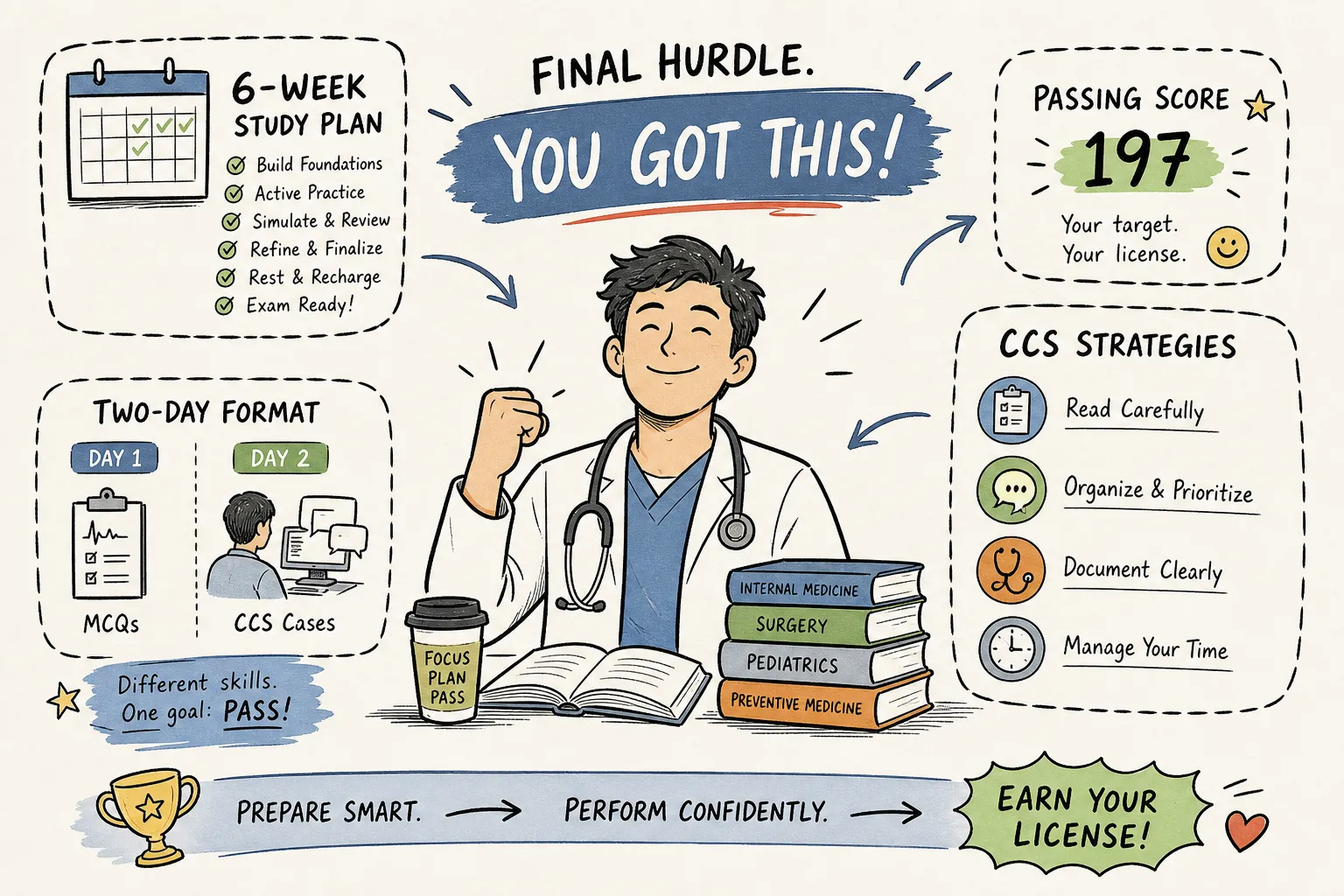
Step 3 is a two-day exam, and understanding the structure of each day shapes how you should prepare. Day 1, called Foundations of Independent Practice (FIP), contains 232 multiple-choice questions across 12 blocks of 18-20 items each, with 30 minutes per block and no case simulations. Day 2, called Advanced Clinical Medicine (ACM), has 180 MCQs across 9 blocks, plus 13-14 Computer-based Case Simulation (CCS) cases. Each CCS case runs in real time with a 10 or 20-minute cap, requiring you to enter orders, request diagnostics, initiate treatment, and advance the case clock. This is not a feature of Step 1 or Step 2 CK, and it changes what you need to practice.
Eligibility, Application, and Scheduling Logistics
Core requirements before you can apply
To sit for Step 3, you must have passed both Step 1 and Step 2 CK and hold your medical degree. US and Canadian graduates from LCME- or COCA-accredited schools apply after degree conferral. IMGs must hold a current, unexpired ECFMG Certification in addition to passing both prior steps. The USMLE recommends completing at least one year of accredited US postgraduate training before sitting for Step 3, which is why most candidates take it during PGY-1 or PGY-2.
Applying through FSMB and booking with Prometric
Applications go through FSMB. Submit the Certification of Identity form if one isn’t already on file, select a 3-month eligibility window, and wait for your scheduling permit to arrive by email. Use that permit to book both exam days at the same Prometric center. Day 2 must follow Day 1 by no more than 14 calendar days. The 2026 exam fee is $955, non-refundable, and the exam is available year-round except during the first 14 days of January and on major local holidays.
What the Passing Score Means and How Results Are Calculated
The 200-point benchmark and what it actually requires
The current Step 3 passing score is 200 on the three-digit scale, updated as of January 1, 2024, raised from the prior 198 threshold. Scores are reported on a scale of 1 to 300 alongside an overall PASS/FAIL result. USMLE does not use a fixed percentage of correct answers, but most published estimates put the required correct-answer rate at roughly 60%. The score report includes a standard error of measurement of approximately 7 points, which matters if your result is close to the threshold.
How CCS cases factor into your final result
CCS cases are not a bonus section. They are scored and contribute approximately 25% of your final Step 3 score, with the MCQ portion accounting for the remaining 75%. A weak CCS performance can pull an otherwise solid MCQ score below passing. Score reports are posted to the registering organization’s secure web portal after electronic delivery to NBME and quality review. USMLE does not release results by phone, email, or fax.
The Content Areas That Carry the Most Weight
Day 1 priorities: biostatistics, ethics, and applied science
Biostatistics and Epidemiology/Population Health/Medical Literature Interpretation is the single highest-weighted content domain at 11-13% of the exam. Day 1 leans heavily on this area, along with Social Sciences (communication, ethics, patient safety) at 7-9%. Residents who dismiss biostatistics because it feels academic pay for it on Day 1. Interpreting confidence intervals, NNT, sensitivity and specificity, and study design is directly testable and appears in multiple question formats, including pharmaceutical advertisement analysis.
Day 2 priorities: clinical systems by weight
On Day 2, organ-system content breaks down as follows, with study time best allocated to match these proportions rather than spread evenly across all systems:
- Cardiovascular: 9-11%
- Nervous System and Special Senses: 8-10%
- Respiratory System: 8-10%
- OB/GYN: 7-9%
- Gastrointestinal: 6-8%
- Endocrine and MSK: 5-7% each
Spending equal time on every system is one of the most common preparation mistakes among residents working with limited daily study hours.
Practice and Resources for USMLE Step 3
Building the right resource stack
The most consistently effective Step 3 combination is UWorld Step 3 QBank as the primary question bank, CCSCases.com for dedicated case simulation practice, and Master the Boards Step 3 as a supplementary review tool for reinforcing gaps. AMBOSS is a credible second Qbank option but rarely outperforms UWorld as a primary driver. What strengthens any resource stack is pairing Qbank work with materials that reflect what’s currently being tested on recent exams, not just what appears in standard prep books.
Where recall-based materials give time-strapped residents an edge
Residents managing limited study time tend to get the most traction from resources built around what’s actively appearing on recent Step 3 administrations. Many residents find that a single consolidated recall file, used alongside their Qbank, helps bridge the gap between standard prep book coverage and what the exam actually asks on test day. Rather than managing multiple sources, the goal is pairing high-yield, current content with consistent question practice. RecallMastery’s Step 3 recall files and Step 3 high-yield notes are designed for exactly this workflow: physicians in residency with narrow daily study windows who need focused, regularly refreshed content without the overhead of juggling multiple resources.
Pacing the 6-8 week window without burning out
A realistic daily target during heavy inpatient rotations is 20-30 questions, with 40-60 on lighter days or days off. Consistency matters far more than volume. Use the following weekly structure as a framework, adjusting around your call schedule:
- Weeks 1-2: Content review of high-weight domains (biostatistics, cardio, neuro) alongside daily Qbank blocks.
- Weeks 3-5: Full Qbank push targeting 40-60 questions per day where schedule allows, with CCS introduction starting in week 4.
- Weeks 6-7: Dedicated CCS practice daily, full timed blocks, and NBME practice materials.
- Week 8 (if available): Light review of identified weak areas and logistics confirmation. Rest at least 48 hours before Day 1.
CCS Case Preparation: The Section Most Residents Underestimate
How case simulations actually work on exam day
Each CCS case presents a patient scenario and requires you to enter orders, request diagnostics, initiate treatments, and advance the case clock. The interface rewards a logical, systematic approach rather than speed. The most common management mistakes include ordering treatment before completing workup, skipping follow-up steps, and mismanaging the case timer. These cases are not testing obscure diagnoses. They test whether you manage straightforward presentations in the correct sequence, the way a competent independent physician would.
The practice tools that build CCS fluency
CCSCases.com is widely used for replicating the exam interface and case flow, making it the go-to dedicated simulator for most Step 3 candidates. UWorld’s built-in CCS cases are also useful, particularly for candidates already working through the Qbank. The critical principle here is active, timed practice starting at least two to three weeks before your exam date. Reading about CCS strategy without practicing in the actual interface does not translate to exam-day fluency. Do enough timed simulations that the sequencing and order-entry feel automatic before you sit for Day 2.
Go In Knowing the Exam Cold
Passing Step 3 during residency is not about finding extra hours in your week. It’s about using the right resources efficiently and covering the right content in the time you actually have. The two-day format, the 200-point passing threshold, and the CCS cases are all manageable once you understand exactly what the exam demands.
A focused 6-8 week plan built around a strong Qbank, dedicated CCS simulator practice, and high-yield recall materials gives you what you need to clear this final licensing milestone. Build your study allocation around the content areas that carry the most weight. Practice your CCS cases until the interface and sequencing feel routine. Go in knowing the format thoroughly before Day 1. That combination consistently gets residents through this final licensing milestone.
For residents who need a single current resource rather than a stack of sources, RecallMastery’s regularly updated recall files consolidate what you need without adding management overhead to an already demanding schedule.
Study from what the exam is actually testing
RecallMastery’s USMLE Step 3 recalls are concept-based, updated monthly through your test date, and delivered as a single file you can open on any device. Also worth a look: USMLE Step 3 High-Yield Notes.