

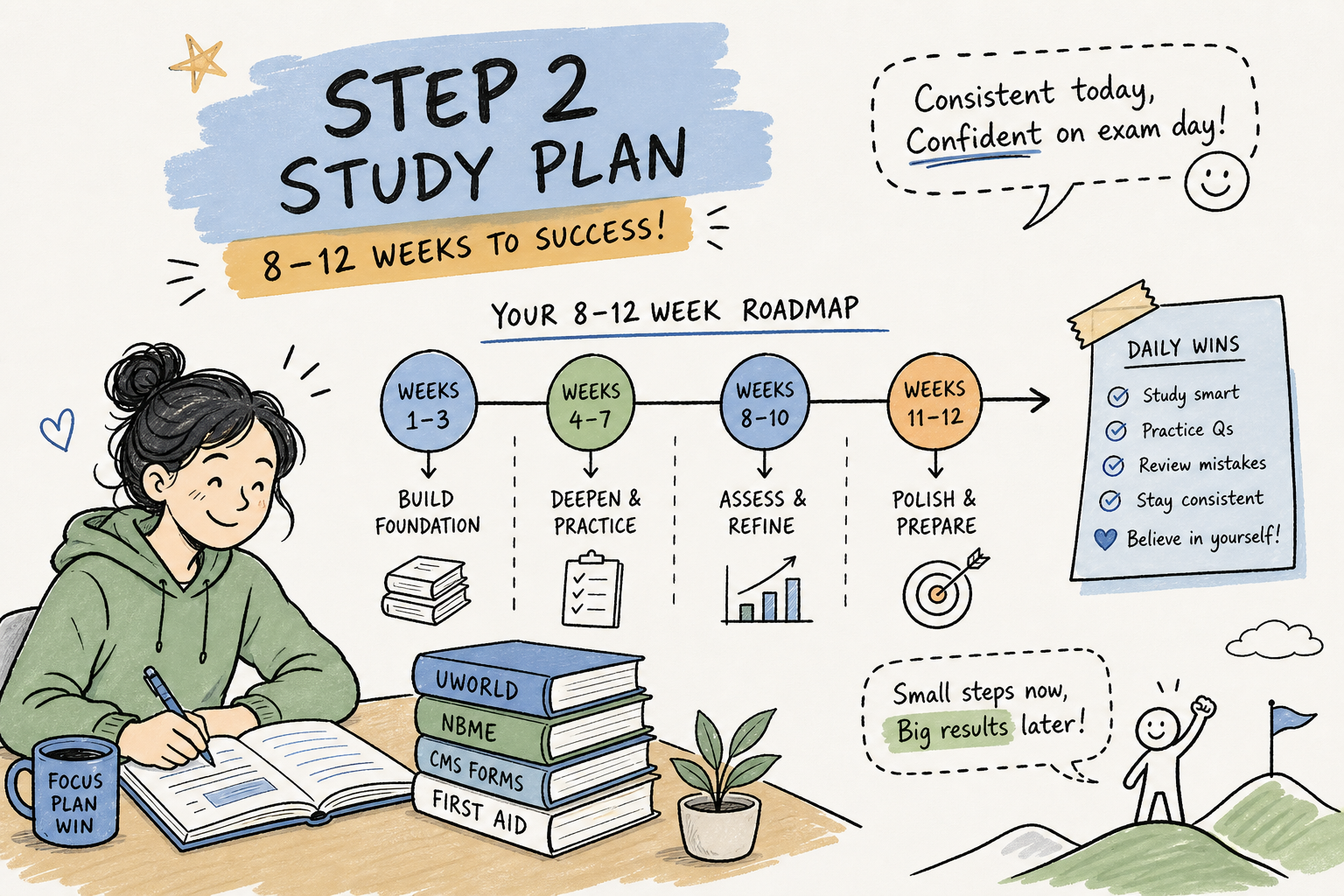
Many students report losing their first three to five days of dedicated prep building the plan instead of running it. They open Reddit threads, compare spreadsheets, watch YouTube breakdowns of other people’s schedules, and end up more confused on day five than they were on day one. A USMLE Step 2 study schedule feels overwhelming because there are genuinely too many variables stacked on top of each other: how many weeks to dedicate, which systems to cover first, how many questions to hit per day, and when to drop in your practice exams.
This article cuts through that. What you’ll find here is a recommended framework for an 8- to 12-week block, a week-by-week system coverage sequence grounded in the actual exam blueprint, daily question targets by timeline, and a clear NBME placement schedule. One more thing worth flagging early: students who tend to score highest aren’t using more resources than everyone else. They’re using fewer, better ones. That principle shows up throughout this plan, and it matters more than almost anything else when you’re trying to execute efficiently under time pressure.
How to choose between 8, 10, and 12 weeks
Timeline selection isn’t a preference. It’s a diagnostic decision. The right length depends on three things: your baseline NBME score, how recently you finished your clinical clerkships, and whether you’re balancing any part-time rotation or work obligations during dedicated prep. The further removed you are from clerkships, the larger the knowledge gap you’re working against, and the more buffer you need to close it without cramming.
Timeline also directly controls your daily intensity. A 12-week Step 2 CK study schedule runs at 60, 90 questions per day. An 8-week plan requires 80, 110 questions per day to cover the same volume. You’re not just choosing how long to study. You’re choosing how hard each individual day has to be.
Signs you need the full 12 weeks
The 12-week profile: you finished your core clerkships more than six months ago, your baseline NBME sits below the 50th percentile, or you’re juggling part-time clinical responsibilities during dedicated prep. Students in this category sometimes resist a longer timeline because it feels like an admission of weakness. It isn’t. When the gap between where you are and where you need to be spans multiple systems, 12 weeks is the only realistic way to close it without burning out in week six.
The 12-week plan also gives you room to absorb content properly. At 60, 80 questions per day in the early phase, you have actual time to review explanations thoroughly instead of skimming them to hit a daily quota.
Why 8 weeks works for a strong baseline
The 8-week plan fits students who finished third year recently, have a baseline NBME above the 60th percentile, and built a solid foundation in internal medicine and surgery during shelf prep. This is the most popular dedicated window for a reason: it’s long enough to do two meaningful passes through high-yield content but short enough to sustain the daily intensity required. If you can commit eight to ten study hours per day without compounding fatigue across weeks, eight weeks is the sweet spot.
USMLE Step 2 study schedule: the three phases that anchor your prep
Regardless of whether you choose 8, 10, or 12 weeks, every effective Step 2 CK study schedule runs through three distinct phases. Skipping straight to timed mixed blocks on day one is one of the most common and costly mistakes students make. The three-phase structure prevents that.
Phase 1: Foundation and system review (weeks 1, 3)
The goal in this phase is to fill content gaps, not demonstrate mastery. Do questions in tutor mode so you can read explanations in real time. Keep your daily question load moderate, 60, 80 per day, with the remainder of your study time allocated to content review and notes.
Prioritize the highest-weight systems first, specifically internal medicine (50, 60% of the exam) and surgery (25, 30%), as defined by the official USMLE content blueprint. Students who skip this phase and go straight to timed blocks often see their scores plateau early because they’re practicing clinical reasoning on a shaky content foundation.
Phase 2: Intensive practice and mixed blocks (weeks 4, 8)
This is where volume and intensity climb sharply. Shift to timed blocks, push to 80, 110 questions per day, and move from system-based to mixed-subject blocks that simulate actual exam conditions. UWorld’s analytics become essential here: check your performance by system weekly, identify the bottom quartile, and allocate extra review time there. Take your first NBME during this phase as a mid-point diagnostic, not a confidence check. For guidance on how many practice NBMEs you should take and which forms matter most, consult resources that compare form predictive value and timing.
Phase 3: The final push (last 2, 3 weeks)
The final phase is about stamina and reinforcement, not new content. Run through your second pass of incorrects and flagged questions, take full NBME practice exams spaced roughly five to seven days apart, and replace heavy content review with lighter daily reinforcement. Spacing exams this way ensures you have enough time to meaningfully review each form before sitting the next one. The biggest trap in this phase is overhauling your strategy because one NBME score came in lower than expected. Stick to the system. A consistent upward trend across multiple forms is a far stronger readiness signal than any single data point.
USMLE Step 2 study schedule: week-by-week system coverage
Knowing you need to “cover all the systems” is useless without knowing which order to cover them in. The official USMLE Step 2 content blueprint gives you the answer directly. Front-load the highest-weight content so it gets the most practice time across your dedicated block, not the least.
Which systems to prioritize in weeks 1, 4
According to the USMLE content outline, cardiology carries 8, 10% of exam weight, GI and pulmonology each carry 7, 9%, and musculoskeletal covers 6, 10%. Those four areas alone represent roughly 30, 35% of the entire exam. Start there. A logical week-by-week assignment looks like this: Week 1 covers cardiology and core internal medicine; Week 2 covers GI and pulmonology; Week 3 covers MSK and neurology (6, 8%); Week 4 covers endocrine and renal. Behavioral health (6, 8%) overlaps naturally with internal medicine content and can run parallel to weeks two and three without requiring its own dedicated week.
How to sequence mixed blocks and second-pass topics in weeks 5, 8
After systems coverage wraps up, transition to mixed blocks that mirror real exam format. Continue working through your UWorld incorrect review log systematically rather than randomly. Lower-weight systems like immunology (3, 5%) and hematology/lymphatic (4, 6%) don’t get skipped, but they get proportionally less time than medicine and surgery. Allocate those systems to weekend review sessions in weeks five and six rather than building full dedicated days around them.
USMLE Step 2 study schedule: daily timetable and question blocks
The most important principle in daily scheduling isn’t how many questions you complete. It’s how thoroughly you review them. In practice, high scorers tend to spend roughly 50% of their total study time on review, not on completing blocks. A student who rushes through 120 questions with 20 minutes of review builds significantly less retention than one who does 80 questions with 90 minutes of deep explanation review.
Daily question targets and block structure by timeline
Here are the targets by Step 2 CK study schedule length:
- 8-week plan: 80, 110 questions per day across two to three blocks
- 10-week plan: 70, 100 questions per day
- 12-week plan: 60, 90 questions per day
Each 40-question block takes roughly one hour to complete and 60, 90 minutes to review properly. A workable daily structure looks like this:
- Morning: First question block with full explanation review
- Early afternoon: Content reinforcement session covering the day’s weak topics
- Late afternoon: Second block with targeted review afterward
Keep evenings for light flashcard or recall review rather than new material.
Splitting time between questions and content review
Review in this context doesn’t mean re-reading a textbook. It means reading the full UWorld explanation for every question you missed or guessed on, cross-referencing the high-yield principle behind each one, and reinforcing that principle through a daily review resource you can actually open quickly. Students who try to do this by bouncing between AMBOSS articles, handwritten shelf notes, Anki decks, and UpToDate entries spend more time navigating than learning. The source consolidation problem deserves its own section, because it’s where most students bleed the most time.
Where to place your NBMEs and what scores signal readiness
Students often misplace their NBMEs, either too early before meaningful prep has happened, or too late with no time left to course-correct. The research-based rationale is straightforward: NBMEs are most predictive when spaced at least five to seven days apart, giving you enough time between forms to identify and address weak areas. They’re diagnostic tools first and confidence-checkers second.
The recommended NBME schedule for 8, 12 week prep
Take your first NBME within days five to seven of dedicated prep as a true baseline. Don’t take it before you’ve started studying, and don’t wait until week three. From there, the recommended schedule is: second NBME around weeks three to four, third NBME around weeks five to six, fourth NBME seven to ten days before your exam date, and the Free 120 two to three days out for interface familiarity rather than scoring. That totals four to five full assessments across your dedicated block, spaced at least five to seven days apart so you have time to meaningfully review each one before the next. UWSA1 and UWSA2 are best used mid-to-late prep as supplemental data points; research indicates they tend to run slightly higher than NBME forms, so factor that in when interpreting them.
For 2026 prep, prioritize NBME Forms 13, 14, 15, and 16. These later forms align most closely with the current exam’s clinically dense, multi-step reasoning style. Forms 11 and 12 are still useful for practice volume but tend to underpredict slightly compared to the newer forms. For a practical walkthrough of NBME self-assessment timing and interpretation, see this NBME self-assessment guide.
Score benchmarks to track your trajectory
Use these benchmarks to interpret your trajectory:
- Below 209: Signals major content gaps; almost always requires extending your timeline by two to four weeks
- 210, 229: Meaningful progress but more work needed in identified weak systems
- 230, 249: Solid and exam-ready if the trend is stable or rising
- 250 and above: Competitive for most residency programs
- 260 and above: Strong territory for competitive specialties
The number that matters most isn’t any single score. A consistent 10, 20 point gain across three consecutive NBMEs is a stronger readiness signal than a 255 that appeared in isolation.
Keeping daily review lean without juggling 10 sources
Most students enter dedicated prep carrying UWorld, a second question bank, OnlineMedEd, a Step-Up to Medicine textbook, a shelf Anki deck, and three months of rotation notes. Managing all of those daily creates decision fatigue before the first question block even starts. Twenty minutes every morning disappear to figuring out what to review. That’s not a knowledge problem. It’s a logistics problem, and it has a straightforward fix.
The multi-source trap that kills momentum
The pattern looks like this: a student opens five tabs every morning, skims three of them superficially, and closes the session having done a shallow pass across multiple resources rather than a deep pass on any one of them. Retention suffers. Confidence suffers. The fix isn’t finding the perfect resource combination. It’s eliminating switching costs by committing to fewer sources and going deeper on each one. One primary question bank, one primary assessment tool, and one consolidated daily review resource covers everything a high-scoring Step 2 candidate actually needs. For a high-level overview of efficient Step 2 CK resource selection, this Step 2 CK study guide is a useful primer.
How a single consolidated recall file fits into daily review
The common thread among high scorers is a single consolidated review file for daily reinforcement, something that brings together high-yield topics, clinical decision points, and key exam patterns in one place rather than spread across Anki, handwritten notes, and a textbook. The practical goal is straightforward: instead of opening four sources during your review session, you open one.
RecallMastery’s Step 2 CK recall file is designed around this approach. It consolidates high-yield content in a single accessible format structured around concept-based review rather than rote memorization, the kind of retrieval-focused method that aligns with how USMLE exams actually test clinical reasoning. It’s intended to slot in as the daily reinforcement layer alongside UWorld, not to replace your question bank. If you want to evaluate whether the format fits how you study, free sample files are available before you commit to the full resource.
Building your schedule comes down to execution, not perfection
A well-built USMLE Step 2 study schedule isn’t the one with the most elegant spreadsheet. It’s the one you can actually execute consistently from day one through exam day. The decisions that matter: pick the right timeline based on your baseline and rotation status, follow the three-phase framework so your prep builds systematically rather than randomly, hit your daily question targets, and place your NBMEs strategically so they give you actionable data at each stage.
Keep your review source simple enough that you can open it and get to work in under two minutes. A realistic Step 2 CK study schedule you can execute beats a perfect one you never follow. If you’re entering dedicated prep and want to eliminate the “what do I review today” problem from your daily workflow, explore RecallMastery’s Step 2 CK recall file as a starting point, and build your review block around the work that actually moves your score.