

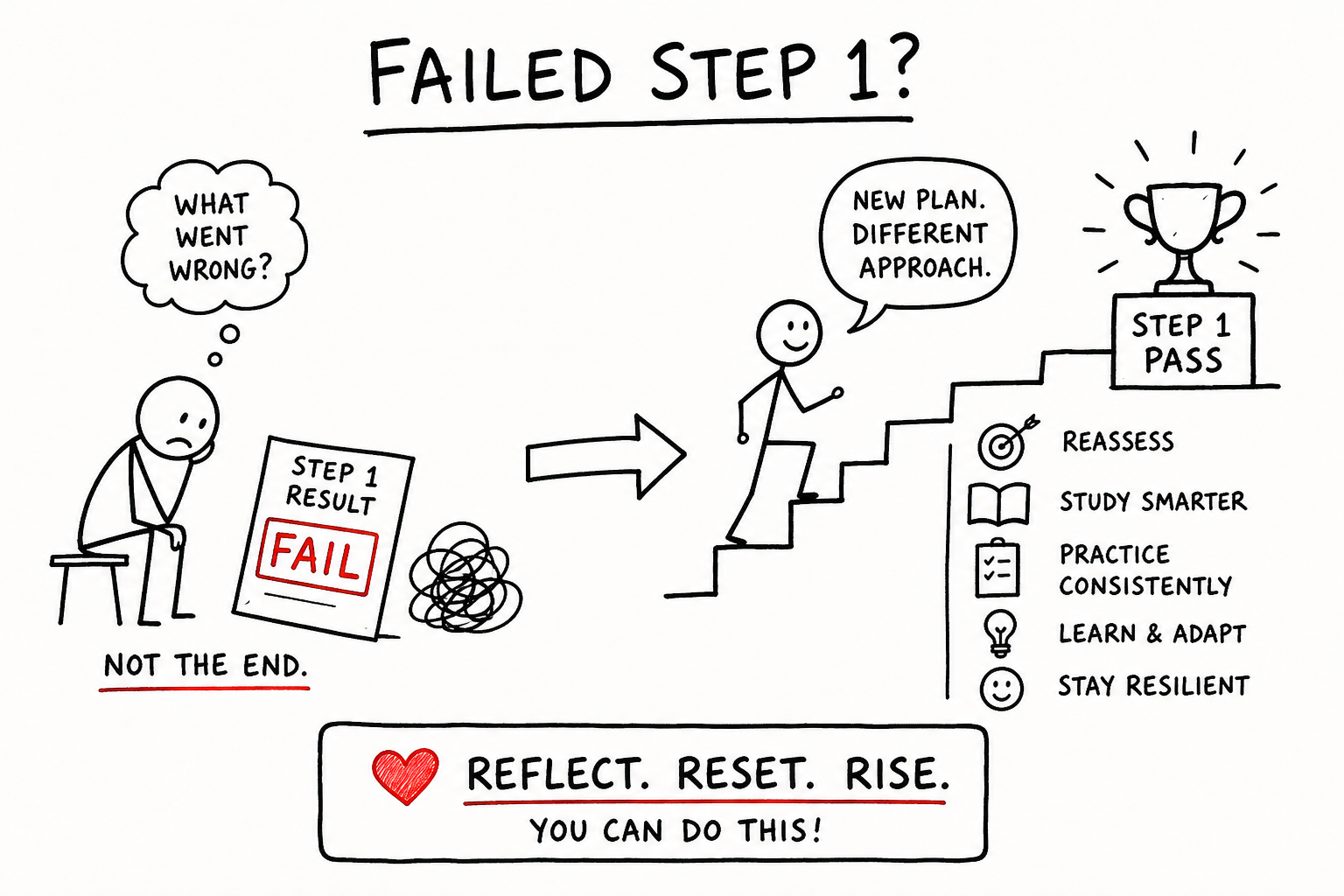
What should you do differently if you failed USMLE Step 1? It’s the right question to ask, and asking it already puts you ahead of retakers who simply schedule the exam again and hope for a different result. Failing Step 1 is more common than the medical community openly acknowledges. Roughly 10, 15% of first-time takers don’t pass, and among repeat examinees, the overall pass rate sits around 50, 55%, with US MD students closer to 70, 71% and IMGs around 52, 54%, according to USMLE performance data. You are not an outlier, and you are not the first person to sit with that score report and feel like the floor dropped out.
But here’s the hard truth: retaking the exam without changing your approach greatly increases the risk of repeating the same outcome. The students who pass on their retake aren’t smarter. They study differently, and that distinction is everything.
This article gives you a prioritized action plan: why you failed, what to change, how to read your score report like a roadmap, and a concrete retake timeline that actually moves the needle. At RecallMastery, we’ve worked through this process with students who’ve been through this exact situation, and the patterns are recognizable and fixable.
Why Most Students Fail Step 1 (and It’s Rarely What They Think)
The most common explanation retakers give themselves is “I didn’t study enough.” That’s almost always the wrong diagnosis. More hours on the wrong approach just produces more of the same result.
Content Gaps Driven by Surface-Level Studying
The majority of Step 1 failures come from content processed too shallowly. Reading First Aid cover-to-cover without ever testing yourself isn’t studying, it’s a false sense of coverage. You recognize the material when you see it, but you can’t retrieve it or apply it under pressure. This isn’t a time problem. It’s a method problem.
The Memorization Trap That Kills Concept Retention
Rote memorization gets you through preclinical shelf quizzes because those tests reward recognition. Step 1 doesn’t. Its vignette-based questions test mechanism and application, not list recall. When a question asks why a patient develops a specific finding given a specific drug mechanism, memorized bullet points don’t give you enough. Understanding does. This is the core difference between students who pass and those who don’t.
Poor Resource Selection and Overload
Too many resources, too little mastery. Students who juggle five different prep tools often master none of them. The specific failure pattern: spreading effort across low-yield material instead of going deep on UWorld, First Aid, and NBME practice exams. Resource discipline is a skill, and many retakers haven’t developed it yet.
What Should You Do Differently After Failing USMLE Step 1? Start With the Score Report
Most retakers glance at their score report once and move on. That’s a significant mistake. The report isn’t a final verdict, it’s a map, and it should drive the entire structure of your retake study plan.
Understanding the Weak, Marginal, and Strong Flags
The report organizes your performance into three tiers: weak, marginal, and strong. Weak flags are your top priority. Marginal flags get secondary attention. Strong areas need only maintenance. The goal isn’t to re-study everything equally, it’s to direct your time where the score gap is widest. Treating all areas the same is how you waste eight weeks.
Systems vs. Disciplines: Where to Dig First
The report breaks down performance across organ systems and foundational disciplines like pathology, pharmacology, and physiology. Based on the USMLE content outline, pathology alone accounts for roughly 44, 54% of discipline-weighted questions, while physiology covers approximately 30, 40%. Weak flags in these two disciplines carry more weight than almost anything else on the report because they underlie the majority of exam content. Retakers who analyze their score report this way find their focus narrows naturally and productively.
Cross-Referencing the Report With Your Practice Data
The score report becomes far more useful when you combine it with your UWorld category percentages and NBME practice exam performance. Overlap between report flags and consistently low Qbank percentages reveals your actual problem areas. That combined picture, not either source alone, should drive your retake plan.
The Resource Audit Retakers Skip (But Shouldn’t)
Before you add anything new to your study stack, take stock of what you already used. Most retakers don’t need more resources. They need to use fewer, better. This is the audit step most people skip entirely.
What to Cut From Your Previous Study Plan
Identify the low-yield patterns: passive video watching without active review, reading without testing, and chasing peripheral resources instead of mastering core ones. If a resource was in your plan last time and didn’t produce measurable Qbank improvement, it doesn’t earn a spot this time. Be ruthless about this.
Shifting From Memorization-Heavy Tools to Concept-Based Learning
This is where the approach changes fundamentally. Tools that reinforce the “why” behind mechanisms produce more durable knowledge for application-style questions than tools built around fact lists. RecallMastery is built around concept-based recall rather than rote memorization, the goal is to understand material well enough to apply it under pressure on an entirely unfamiliar vignette, not just recognize it when prompted. That’s the shift that makes the difference for retakers.
The Core Stack That Evidence Supports
Keep it simple: UWorld as your primary question bank, First Aid as an integrated reference rather than standalone reading, and NBME self-assessments as diagnostic tools throughout. Add one concept-reinforcing recall resource and a spaced repetition system like Anki. That’s the full stack. Everything else fragments your attention and dilutes your mastery.
How to Rebuild Your Retake Study Strategy From the Ground Up
Resource selection matters, but how you study matters more. The method changes that separate retakers who pass from those who don’t center on active recall, structured NBME use, and daily block discipline.
Active Recall Over Passive Review
Every study session should end with testing, not reading. Self-quizzing, teaching concepts out loud, and working through untimed practice blocks before timed ones are all forms of active recall. Research on retrieval practice, including work building on Roediger and Karpicke, consistently shows retrieval practice outperforms rereading for long-term retention, a finding that holds especially well for application-heavy exams like Step 1. If you close your notes after two hours of reading and can’t reconstruct what you just covered, you didn’t study. You read.
How to Use NBME Practice Exams as a Study Tool, Not a Checkpoint
Most retakers treat NBME practice exams as a readiness check at the end of their prep. That’s backwards. Schedule NBMEs every one to two weeks starting early in your dedicated period. Use them to track progress and identify persistent weak areas, a consistent upward trend across exams matters more than any single score. Aim to reach passing-range performance with at least two to three weeks still left in your study window, so you have time to address anything that remains.
Structuring Daily Blocks to Avoid Burnout and Maintain Retention
Eight to eleven hours of daily study is common during dedicated prep, but unstructured hours produce poor retention. A workable daily structure: morning content review of weak areas, midday Qbank blocks with deep error analysis after every question, afternoon spaced repetition review. Consistency across the week beats heroic single-day efforts followed by crash days. The students who pass are rarely the ones who studied hardest on any given day. They’re the ones who showed up the same way every day.
A Realistic 8, 16 Week Timeline for Your Step 1 Retake
The gap between retakers who pass and those who don’t is largely explained by two things: underestimating the timeline required and repeating the same preparation approach. Choosing the right window is one of the clearest decisions you’ll make.
The 8-Week Plan (Only If the Baseline Is Already Strong)
Eight weeks is the minimum viable timeline for retakers who scored close to passing and have narrow, clearly identified gaps. As a practical benchmark used by many advisors: you should be starting NBME practice in the 60% correct range or above, with a plan to complete 3,000 or more UWorld questions across the period, and a structured schedule locked in from day one. Without those conditions in place from the start, eight weeks sets up a second failure. Be honest with yourself about whether your baseline actually supports it.
The 12, 16 Week Plan for Most Retakers
Twelve to sixteen weeks is the recommended window for most students retaking after a failure. Weeks one through four: targeted weak-area review driven by your score report data. Weeks five through ten: full-length practice blocks, daily Qbank work, and weekly NBME exams. Weeks eleven through sixteen: exam simulation, error pattern review, and final refinement. Based on qualitative outcome patterns, retakers who follow a structured 16-week plan with consistent practice exam improvement tend to show pass rates well above the repeater average. Longer, structured timelines with quality execution consistently outperform compressed, reactive ones.
How to Know You’re Actually Ready to Schedule the Exam
Readiness isn’t a feeling. It’s a performance threshold. The commonly recommended benchmarks: two to three consecutive NBME forms at or above passing range, consistent UWorld performance above 70%, and no remaining weak flags from your score report. When those criteria are met, schedule the exam. Waiting for a feeling of certainty that never arrives is how some retakers delay indefinitely and run out of time or attempts.
The Logistics Retakers Often Ignore Until It’s Too Late
Fixing your study strategy is the main job. But there are institutional and regulatory realities that need attention early, not the week before your exam date.
Retake Rules, Attempt Limits, and Timing Windows
As of 2026, USMLE allows a maximum of four lifetime attempts at Step 1. Within any 12-month period, students can attempt the exam up to three times. A fourth attempt requires at least 12 months from the first attempt and six months from the most recent attempt. State medical boards may impose stricter limits for licensure, so verify your target state’s requirements now, not after you’ve scheduled. The 2026 format change to 280 MCQs across 14 blocks, effective May 14, 2026, also affects scheduling logistics for anyone with appointments near that date, and you can review details in the 2026 USMLE bulletin, though the retake policies themselves are unchanged.
What a Failed Step 1 Means for ERAS and Residency Applications
USMLE transcripts show all attempts and outcomes. Program directors see failed attempts. This doesn’t automatically disqualify a candidate, but it requires a strong retake performance and a clear narrative about what changed. Addressing the failure proactively in your program communications is almost always better than hoping no one notices. Competitive specialties weigh this more heavily; primary care fields tend to be more flexible. Your strongest counterargument is a solid Step 2 CK score and a clear story of deliberate remediation. For practical guidance on how to present a failed Step exam on ERAS without undermining your application, see targeted advice from residency application advisors.
What to Communicate to Your Medical School
Most medical schools require Step 1 passage before clinical rotations begin, and many have formal remediation policies that kick in immediately after a failure. Know your school’s specific policy, communicate early with your academic advisor, and document your structured retake plan. Schools respond far better to students who are proactive and organized than to those who go quiet after a failure. Silence is interpreted as a lack of plan, and that creates additional problems.
What Should You Do Differently If You Failed USMLE Step 1? The Work Starts Now
Failing Step 1 is a data point, not a verdict. The students who pass on retake stop memorizing and start understanding, treating the score report as a roadmap rather than a rejection letter. The rebuild is methodical, not panicked.
The priority actions: run the resource audit, interpret your score report systematically, and build a structured 12, 16 week timeline with concept-based tools that reinforce understanding. Handle the logistics before they become emergencies. At RecallMastery, our usmle step 1 recalls are built around exactly this kind of retake strategy, because we know what breaks down the first time and what needs to replace it.
You have the information. The gap between knowing what to do and actually doing it closes the moment you start.