

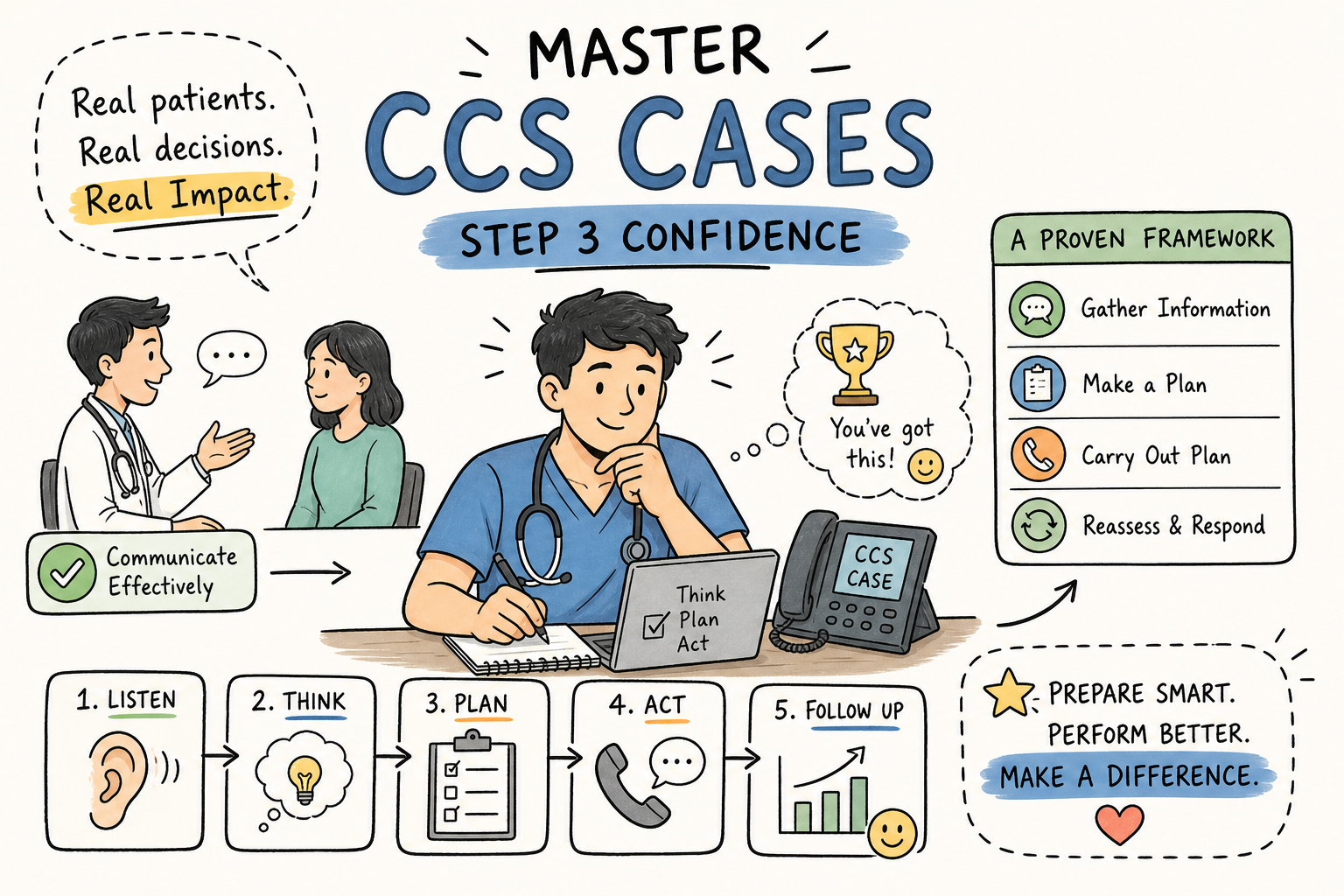
The CCS section trips up more candidates than the MCQ blocks, not because it’s harder, but because most people under-prepare for it. They spend weeks drilling question banks, show up to Day 2 of the exam, and freeze when the simulation software launches. This guide fixes that. You’ll get a clear breakdown of how USMLE Step 3 CCS cases work, which case types appear most often, a repeatable framework you can apply to every simulation, the order-entry mistakes that silently kill your score, and a practical 4-week plan to build real case fluency.
Candidates who pair solid MCQ preparation with a dedicated CCS strategy arrive at test day prepared for both halves of the exam. RecallMastery’s Step 3 recall notes handle the MCQ side: consolidated, concept-driven content updated for the current exam format. This guide handles the CCS side.
What the USMLE Step 3 CCS Section Actually Measures
Most candidates assume CCS is a knowledge test. It isn’t. It’s a clinical decision-making and sequencing test. Before you can run cases well, you need to understand what the scoring algorithm is actually rewarding.
CCS takes place on Day 2 of Step 3. After completing MCQ blocks, you get a 6-minute tutorial and then face 13 to 14 computer-based case simulations. Each case runs on a real-time clock of either 10 or 20 minutes. Inside each case, you control a simulated clinical environment: you order labs, imaging, medications, and consults, perform physical exams, and advance the clock to see how the patient responds. Cases simulate clinical timeframes ranging from minutes to months within those real-time windows. For an authoritative overview of the simulation format and how cases are presented, review the USMLE’s official description of computer-based case simulations.
The scoring algorithm evaluates three things: whether you ordered the right actions, whether you ordered them in the correct sequence, and whether you ordered them without harmful delay. The USMLE is explicit: indicated actions taken in the wrong order or after unnecessary delays receive zero credit, even if the action itself is clinically correct. Harmful or non-indicated orders actively reduce your score. CCS rewards candidates who think in clinical sequences, not just clinical facts.
USMLE Step 3 CCS Cases: The Scenarios That Appear Most Often
You won’t see 13 random cases on exam day. The section draws from a predictable pool of high-prevalence clinical scenarios. Knowing these in advance removes most of the uncertainty from the simulation.
Cardiovascular emergencies appear in the majority of exams. Acute MI and unstable chest pain are the most common. Sepsis and septic shock cases test your ability to execute the 1-hour bundle: cultures first, then fluids, then antibiotics, then vasopressors if needed. Ischemic stroke cases demand rapid sequencing, specifically a fingerstick glucose and non-contrast CT head before any other intervention.
Respiratory failure and COPD exacerbations round out the emergency category, testing oxygen titration, bronchodilators, steroids, and appropriate escalation to BiPAP or intubation. A significant share of Step 3 CCS cases are set in an outpatient office, not an ER. Type 2 diabetes management, hypertension follow-up, COPD optimization, heart failure, and CKD all appear regularly. These cases test whether you know the right medications, the appropriate monitoring intervals, when to refer, and when to add preventive care orders like vaccines and statin therapy. Ambulatory cases reward thoroughness and appropriate follow-up planning, not just acute intervention.
Expect at least one or two psychiatry cases, including major depression and alcohol withdrawal. Alcohol withdrawal requires CIWA scoring, benzodiazepines, and thiamine, get the sequence wrong and you lose credit on a manageable case. Pediatric cases commonly involve febrile seizures, nephrotic syndrome, and child abuse; the child abuse scenario requires a mandatory CPS notification order, which candidates frequently omit. OB cases typically involve third-trimester bleeding: two large-bore IVs, type and crossmatch, RhoGAM if Rh-negative, and an obstetrics consult, in that order.
A Repeatable Framework for Running Any CCS Case
The biggest mistake candidates make is approaching each case differently based on the chief complaint. Instead, use one consistent framework and adapt it to the clinical context. This builds speed, reduces cognitive load, and prevents you from skipping steps under time pressure.
Every case, regardless of setting, follows the same three-phase structure. Phase one is stabilization: secure IV access, apply monitors, give oxygen if saturation is below 92%, and address any immediate life threats. In phase two, order only what the clinical picture justifies, targeted diagnostics, not a reflexive broad panel. Phase three is definitive treatment plus disposition: medications, consults, counseling, preventive care orders, and a clear plan for admission, observation, or discharge with follow-up.
Advancing the clock is how you see lab results, reassess the patient, and demonstrate ongoing management. The correct approach is to advance in short intervals after each major order set, check returning results, reassess vitals, and adjust your management accordingly. Advancing too quickly skips clinical decision points. Never advancing leaves the case stagnant. A practical rhythm: advance 30 to 60 minutes after your initial stabilization and diagnostic orders, then reassess before advancing again.
High-Yield CCS Orders and Timing Mistakes That Drop Your Score
These are the errors that separate candidates who feel good about their cases from candidates who actually score well. The algorithm is unforgiving about sequence, and most of these mistakes are easy to avoid once you know they exist.
The most cited CCS scoring error is ordering antibiotics at the same time as, or before, blood cultures. The algorithm treats simultaneous entry as contaminated cultures, eliminating diagnostic credit for the culture order entirely. The fix is simple: enter culture orders first, advance the clock by one minute, then enter antibiotics. In endocarditis cases, repeat this for three separate culture sets before starting antibiotics. For a practical review of timing and order priorities in acute scenarios, see this guide on high-yield orders and timing for acute scenarios. A second common trap is performing a complete physical exam before stabilizing an unstable patient. In any case where the patient is hemodynamically compromised, stabilization orders come first. The focused exam follows. The complete exam can wait.
Ordering a broad diagnostic panel at case open feels thorough. The algorithm doesn’t reward it. Non-indicated orders that pose risk actively reduce your score, and over-ordering clutters your clinical reasoning without adding credit. On the flip side, delaying life-saving interventions while you gather history or complete an exam is equally penalized. In chest pain cases, aspirin goes in before the full history is complete. In sepsis cases, the 1-hour bundle starts before you identify the exact source. Every order should have a clear clinical justification, if you can’t state it, don’t enter it.
Which CCS Simulators Are Worth Your Time
Not all practice tools prepare you equally for the actual Primum software environment. The distinction matters because the scoring algorithm rewards software fluency as much as clinical knowledge.
CCSCases.com offers the closest match to the actual CCS interface, with real-time case evolution, a large order database, and case-level feedback after each simulation. StudyCCS adds pattern-drilling tools, a score predictor, and high-speed order entry practice, useful for building case tempo. MDSteps focuses on timing feedback and evolving vitals, which helps candidates who know their high-yield CCS orders but struggle with sequencing under the clock. For a vendor comparison that ranks platforms and highlights strengths relevant to Step 3 CCS practice, read the best Step-3 CCS cases platform ranked comparison 2026. The official NBME Primum software is free, uses the exact exam interface, and is essential for software orientation. It lacks grading and analytics, so use it for interface familiarity, not substantive feedback.
Running CCS practice cases without a review protocol is the equivalent of doing Qbank questions without reading explanations. After every case, identify what you ordered out of sequence, what you missed entirely, and whether your clock advancement was appropriate. Track your errors across cases to find patterns. Most candidates make the same two or three mistakes repeatedly. Fixing those specific errors produces more score improvement than running additional cases at random.
A 4-Week CCS Practice Plan Built for the Real Exam
Four weeks is enough time to build meaningful fluency if the practice is structured. Volume matters, but progression and review matter more.
- Week one: Orientation. Run 4 to 5 cases untimed with the official Primum software to build interface comfort, then switch to a CCS simulator with feedback for your remaining cases. Aim for 8 to 10 total cases. Focus on the stabilization phase of each.
- Week two: High-frequency case types. Target cardiovascular, sepsis, and respiratory USMLE Step 3 CCS cases. Run 10 to 12 cases, now timed. Review every case the same session.
- Week three: Ambulatory, psychiatric, pediatric, and OB cases. Run 10 to 12 more cases and focus specifically on sequencing errors from your review logs.
- Week four: Full exam simulation. Run cases back-to-back in 10- to 20-minute blocks to replicate Day 2 conditions. Aim for 8 to 10 cases at full speed, then review for final pattern correction.
If you want a structured schedule with daily targets and progression, consider following a published week-by-week CCS practice plan leading up to Step 3 that maps volume to focused review goals.
CCS is only one portion of your Step 3 score. The MCQ blocks on Day 2 still require a strong clinical knowledge base, and neglecting them in favor of simulator time will cost you on Day 2. Candidates who perform well across both sections anchor their MCQ preparation in a high-yield, concept-based resource and reserve dedicated daily blocks for CCS simulation. RecallMastery’s Step 3 recall notes are built specifically for this dual-prep model, consolidated, concept-driven content updated for the current exam format that reinforces the same clinical logic you apply when running cases. Pairing those notes with your CCS simulator sessions means you’re not preparing for two separate exams. You’re building one integrated clinical skillset.
The Bottom Line
USMLE Step 3 CCS cases are learnable. They follow patterns, reward specific habits, and penalize the same avoidable mistakes across nearly every test administration. Run cases in sequence. Order cultures before antibiotics. Stabilize before you examine. Advance the clock deliberately. Practice on software that gives you real feedback.
Don’t let your MCQ preparation atrophy while you focus on simulations. The candidates who score well on Step 3 treat both sections as a system, not as separate battles. Build your CCS framework, run your cases with intention, and show up to test day knowing exactly what to do when that first patient appears on screen.