


Hello, I hope you are doing well. This blog will be quite large, and we have tried our best to include as much information as possible to help you achieve a score of 280.
📋 Table of Contents
- Why This Guide Is Different
- The High Scorers We Analyzed (270–281)
- Complete Resource Tier List (2026)
- The Ideal Study Timeline for 270+
- NBME Mastery: The Secret Weapon
- 5 Non-Negotiable Strategies of 270+ Scorers
- Ethics, QI & Biostats: The Free Points
- Test-Taking Strategies That Actually Work
- Exam Day: What to Expect in 2026
- Common Mistakes to Avoid
- Score Prediction: How Accurate Are Practice Exams?
- FAQs
1. Why This Guide Is Different
There are hundreds of USMLE Step 2 CK guides online, but most offer generic advice written by people who never took the exam. This guide is different.
We analyzed, and asked every high-score write-up (270–281) from students in the past year (2025–2026). Instead of opinions, you’re getting data-driven consensus from students who actually achieved what you’re aiming for.
Here’s what we found: the path to 270+ isn’t about secret resources or being a genius — it’s about the right resources, in the right order, with the right review strategy. Every single high scorer we analyzed shared remarkably similar approaches, with only minor variations.
🔑 The Key Insight
Step 2 CK is more about mindset and test-taking strategy than raw knowledge. Multiple 270+ scorers explicitly stated: “I am no more intelligent than anyone else. The difference is consistency and strategy.” The exam rewards clinical reasoning over memorization.
2. The High Scorers We Analyzed (270–281)
We reviewed detailed write-ups from the following verified scorers of Step2. Each shared their exact resources, study timelines, NBME scores, and strategies:
281 – Tested May 2025. Used UWorld (80% first pass), AMBOSS HY exam prep, all NBMEs. 4-week dedicated. Never scored below 270 on practice exams. Key: phenomenal 3rd-year shelf prep built the foundation.
280 – Tested December 2025. UWorld (83% first pass), all NBMEs, CMS forms (last 2 per topic), AMBOSS. 10-month prep while working as an intern. Key: Deep analysis of mistakes, grouping questions by topic to build pattern recognition.
277 – Tested July 2025. UWorld 100% (81% first pass), flashcards for EVERY question, combined notes by topic, all CMS forms, AMBOSS Ethics. ~11 months prep. Key: Understanding over memorization, strong test-taking instincts.
275 – Tested late 2025. AnKing matured for Step 1 & 2, all online NBMEs. All shelf scores above 90th percentile. Key: Consistency with Anki, AMBOSS QI/Ethics articles, trust your first answer.
273 – Tested January 2026. UWorld + incorrects, full AMBOSS qbank, NBME 9-16, CMS forms, UW Step 3 biostats. 11 months total prep (2-month dedicated). Key: Maximum question volume, AMBOSS QI study plans x3, full-length simulations.
272 – Tested January 2026. UWorld (56% first pass!), Inner Circle notes, AMBOSS 200 HY, CMS forms, NBMEs 10-15. Key: Shifted from UWorld mindset to NBME mindset in final month, CMS forms were crucial, “delusional self-confidence” on exam day.
263 – Tested February 2026. NBMEs, Divine Intervention podcast, AMBOSS 200 HY, UWorld (80%), CMS forms. Only 31 days dedicated! Key: Google Sheet review method, algorithms list, prioritize NBMEs over everything else.
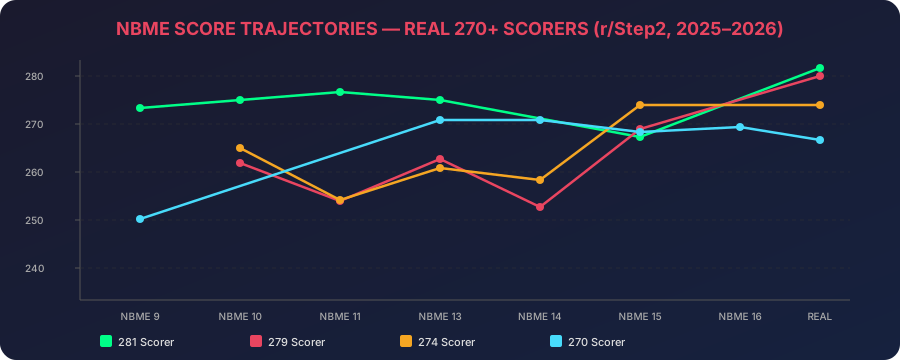
Real NBME score trajectories from verified 270–281 scorers (2025–2026)
3. Complete Resource Tier List for USMLE Step 2 CK (2026)
After analyzing every resource mentioned by 270+ scorers, here is the definitive tier list. Resources are ranked by how many high scorers used them and the impact they reported.
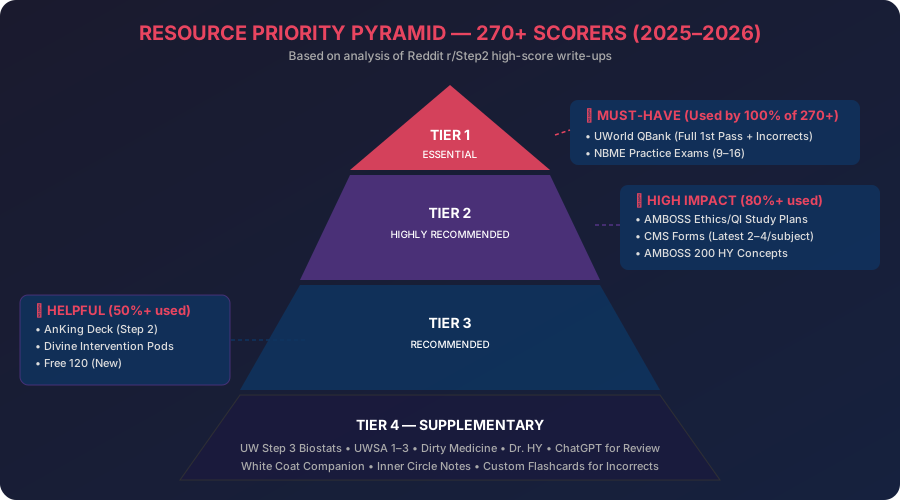
Resource priority pyramid based on 270–281 scorer usage data
Tier 1: Essential (Used by 100% of 270+ Scorers)
📚 UWorld QBank
The undisputed #1 resource. Every single high scorer used UWorld as their primary question bank. First pass averages among 270+ scorers ranged from 56% to 83%.
- How to use: Random, timed or tutored mode (both work)
- Target: Complete at least 1 full pass + all incorrects
- Key insight: UWorld is for learning content, not score prediction
📝 NBME Practice Exams (9–16)
All 270+ scorers took multiple NBMEs. These are the single best predictor of your real score and the most important tool for building “NBME thinking.”
- How to use: Under timed exam conditions, review every question
- Most predictive: NBMEs 13–16 (especially 16)
- Key insight: “NBME 16 had similar vibes to the real exam”
Also, please view our best work. – usmle recalls step 2
Tier 2: Highly Recommended (Used by 80%+ of 270+ Scorers)
🧪 AMBOSS Ethics/QI Study Plans
Nearly every high scorer credited AMBOSS Ethics and Quality Improvement questions. The 270 scorer did them 3 times. These directly appear on the real exam.
- Do: Ethics, QI, Patient Safety study plans
- Also do: AMBOSS 200 High-Yield Concepts
📋 CMS Forms (NBME Subject Exams)
The official NBME shelf exam forms. Used by most high scorers to build the “NBME mindset” — which is different from UWorld thinking.
- Minimum: Latest 2 forms per subject
- Ideal: All 42 forms if time permits
- Key insight: FM & EM forms were unexpectedly high-yield
Tier 3: Recommended (Used by 50%+ of 270+ Scorers)
🃏 AnKing Deck (Step 2 CK)
Powerful for spaced repetition. The 281 scorer had 20k+ matured cards. However, multiple 270+ scorers never touched Anki — it depends on your learning style.
🎧 Divine Intervention Podcasts
High-yield audio content perfect for commutes and exercise. The 263 scorer called Divine “the best resource I didn’t know about.” Listen at 2x speed.
✅ Free 120 (2023 Version)
Take this in the final week. Target: 85%+. Multiple scorers reported it felt closest to the real exam in terms of question vignette length.
Recommended
📊 UWorld Step 3 Biostats
The 270 scorer specifically recommended Step 3 biostats questions. “Biostats on UW step 3 helped” — great for securing those “free” biostats points.
Resources to Skip (or Deprioritize)
Based on high-scorer feedback, these are not worth your time if you’re short on it:
- White Coat Companion: One scorer said “I read a lot of WCC… All was useless for me.” Passive reading is inferior to active question-based learning.
- UWSA 3: Considered poorly calibrated by multiple posters. UWSA 1 & 2 are better.
- Old NBMEs (6–8): The 270 scorer called them “crap, not helpful.”
- Excessive content review books: “Questions > passive reading” was the universal consensus.
4. The Ideal Study Timeline for 270+ on Step 2 CK
Based on analyzing the timelines of all 270+ scorers, here is the optimal study plan. Most scored 270+ with 9–11 months of total prep and a 4–6 week dedicated period.
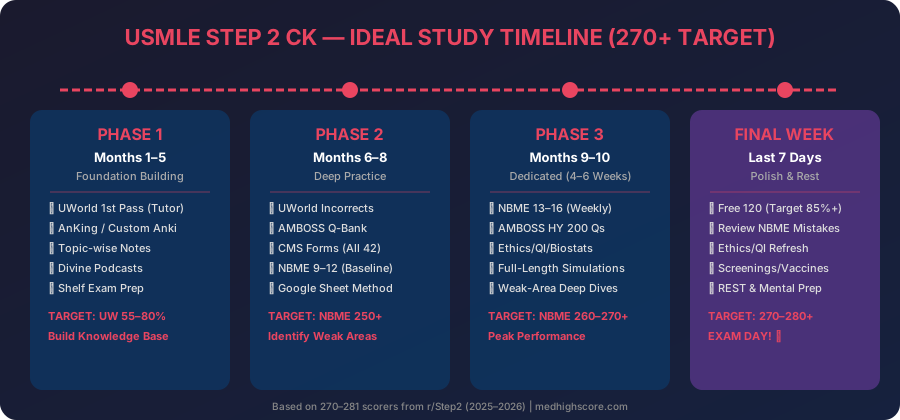
Ideal study timeline for Step 2 CK based on 270+ scorers’ actual timelines
Phase 1: Foundation Building (Months 1–5)
- Complete UWorld first pass in random, tutored mode
- Start AnKing Step 2 CK cards (or make your own flashcards per question)
- Build topic-combined notes from UWorld explanations
- Listen to Divine Intervention during commutes/exercise
- Crush your shelf exams — the 281 scorer said this was his #1 difference-maker
💡 Pro Tip From 281 Scorer
“Start prepping for Step 2 now [during 3rd year]. I didn’t do any specific step 2 prep until my last week of my final clerkship, but I studied my butt off for every shelf exam. I used UWorld + the associated AnKing cards.”
Phase 2: Deep Practice (Months 6–8)
- Complete UWorld incorrects with thorough review
- Start AMBOSS Q-bank for new question formats and blind spots
- Work through CMS forms (latest 2–4 per subject)
- Take NBMEs 9–12 as baseline assessments
- Begin the Google Sheet method for tracking mistakes
Phase 3: Dedicated Period (4–6 Weeks)
- Take NBMEs 13–16 weekly under full exam conditions
- Complete AMBOSS HY 200 Concepts + Ethics/QI study plans
- Do 2–3 full-length 320-question simulations (combine NBME + Free 120 or UW blocks)
- Deep dive into weak areas identified by NBME analysis
- Review algorithms: tachyarrhythmia management, ACLS, preterm labor, ACS, shock types, hyponatremia
Final Week
- Take Free 120 (target 85%+)
- Review all NBME mistakes one final time
- Hammer Ethics, QI, biostats, screenings, and vaccines
- REST. Sleep 7+ hours. Play Minecraft. Take a walk.
- Day before: Zero studying. Mental preparation only.
5. NBME Mastery: The Secret Weapon of 270+ Scorers
If there’s one thing that separated 270+ scorers from everyone else, it’s how they used NBMEs. They didn’t just take them for score prediction — they turned them into the most powerful learning tool in their arsenal.
How 270+ Scorers Review NBMEs
The Google Sheet Method (Used by 263+ Scorers)
Created by a scorer who jumped from 23x to 26x in just 1.5 weeks, this method involves:
- Create a spreadsheet with columns: Question #, Topic, Why Wrong, Content Gap vs Test-Taking Error, Key Concept
- Color-code by specialty (helps identify which areas are bleeding points)
- Separate mistakes into two categories:
- Content Gap (CG): You didn’t know the answer
- Test-Taking Pearl (TT): You knew the content but misread/overthought
- Set a timer for review: 3 min per question at first, then 1.5–2 min as you improve
- Compile a master algorithms list of commonly missed topics (see below)
The Reverse-Engineering Method (Used by 279 Scorer)
“What I found really important was analyzing WHY I got questions wrong — whether the issue was misunderstanding the question, running out of time, or an actual gap in medical knowledge. If it was a knowledge gap, I’d search that specific topic in UWorld and build a small deck of all related questions. Seeing how the same topic is tested in different contexts helped a lot.”- 279 scorer
Commonly Missed Algorithms (From 263 Scorer)
This list was compiled from NBME review by a 263 scorer and covers the topics most frequently causing errors:
| Category | High-Yield Topics |
|---|---|
| Algorithms | Tachyarrhythmia Mx, Preterm Labor Mx, Labor Mx, ACLS, Murmur/CHD evaluation, Hyponatremia Mx, Shock types/Mx, ACS Mx, Thyroid mass eval, HIV dx/mx, Dysphagia eval, Pancreatitis Mx, ATLS, Amenorrhea eval, DSDs eval |
| Pharmacology | Antiarrhythmics, Calcium channel drugs, Drug ADEs |
| Key Topics | Peds genetic syndromes (NF1, TS, myotonic dystrophy, SMA, FA), Toxidromes, Transplant complications, Bone tumors, HPB disorders |
| Diagnostic Interpretation | ECG, CXR, Fetal heart rate tracing, Chest CT, Flow-volume loops |
NBME Score Interpretation
| NBME Form | Predictive Value | Difficulty Level | When to Take |
|---|---|---|---|
| NBME 9 | Moderate | Moderate | Baseline (start with 10 instead per scorers) |
| NBME 10 | Good | Moderate (some outdated Qs) | Early dedicated |
| NBME 11 | Good | Moderate-Hard | Mid-dedicated |
| NBME 12 | Low-Moderate | Variable (vague) | Optional — skip if short on time |
| NBME 13 | High | Hard | 2–3 weeks out |
| NBME 14 | High | Hard | 2 weeks out |
| NBME 15 | Moderate-High | Tricky (“poorly made” per 281 scorer) | 1 week out |
| NBME 16 | Highest | Most like real exam | 5–7 days out |
🔑 Critical Insight
NBME 16 is the gold standard. Multiple scorers independently reported: “NBME 16 had similar vibes to the real exam” and “The actual exam was very similar to NBME 16 in terms of content and difficulty.”
6. The 5 Non-Negotiable Strategies of 270+ Scorers
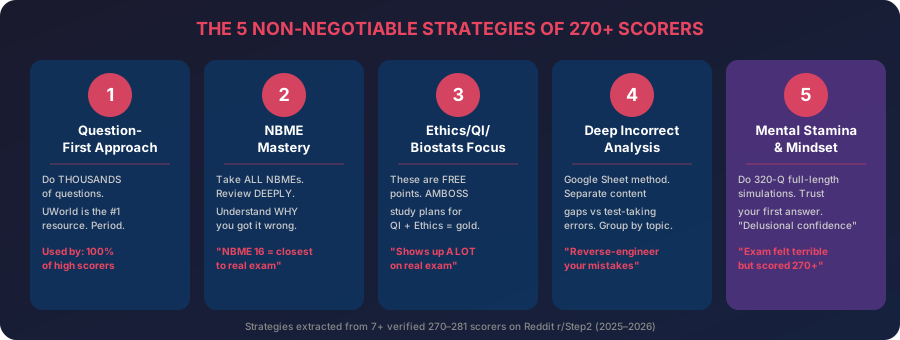
The five strategies consistently used by every 270+ scorer we analyzed
Strategy 1: Question-First Approach
Every single high scorer prioritized active question-based learning over passive content review. The consensus is clear: do thousands of questions. Don’t read textbooks cover to cover.
“UWorld + JAnki deck will take you from 0 to 70%. The other 30% is on you to analyze the questions and develop an algorithm to solve them.”
Strategy 2: NBME Mastery Over Everything
In the final 2–4 weeks, NBMEs become more important than UWorld. The “NBME mindset” is fundamentally different from the “UWorld mindset”:
- UWorld: Tries to trick you with zebra diagnoses, tests deep knowledge of rare conditions
- NBME/Real Exam: Tests the most likely diagnosis, rewards “ruling in” over “ruling out”
- “When you hear hoofbeats, think horses, not zebras” — this is the NBME way
“CMS forms help you focus on high-yield topics and equip you with the mindset you need to solve NBME questions. UWorld teaches you to look for zebras too much. I did not do any UWorld during my last month and I would recommend the same.”— 266 scorer (NBME 10: 226 → Real: 266)
Strategy 3: Ethics/QI/Biostats — The Free Points
This was the most consistent theme across ALL write-ups. Ethics, Quality Improvement, and Biostatistics questions appear in every single block of the real exam, and they’re among the most predictable.
Strategy 4: Deep Incorrect Analysis
Don’t just review what you got wrong — understand why you got it wrong. Was it a content gap or a test-taking error? High scorers track this distinction explicitly.
Strategy 5: Mental Stamina & Mindset
The exam is 320 questions over 9 hours. Mental stamina is trainable — and most high scorers trained it deliberately:
- Complete 2–3 full-length 320-question simulations before exam day
- Combine NBME + UW blocks (e.g., NBME 14 → Free 120 back-to-back)
- Trust your first answer — only change if you have new evidence
- The exam will feel harder than practice. This is normal and doesn’t predict your score.
“Post-exam anxiety is real and I felt like shit and that’s totally normal. LOTS of people got their predicted scores and moved on. FEW who fell off the course would post online and make you fall into reporting bias.”— 270 scorer
7. Ethics, QI & Biostats: The Free Points No One Talks About Enough
If you want to maximize your Step 2 CK score, Ethics, Quality Improvement (QI), and Biostatistics are the highest ROI topics you can study. Here’s why:
- They appear in every block of the real exam (5–7+ biostats Qs per exam)
- They’re highly predictable — the same concepts repeat
- Many students neglect them, so getting them right separates 260 from 270+
What to Study
| Topic | Best Resource | Time Needed |
|---|---|---|
| Ethics | AMBOSS Ethics Study Plan + UWorld Ethics Qs | 3–5 days |
| Quality Improvement | AMBOSS QI & Patient Safety Study Plan (x2–3) | 2–3 days |
| Biostatistics | UWorld Biostats + UWorld Step 3 Biostats + AMBOSS | 2–3 days |
| Preventive Medicine | Screenings & Vaccines (memorize USPSTF guidelines) | 1–2 days |
🔑 From the 270 Scorer
“I did AMBOSS study plans especially QI & Patient Safety x3 times (VERY IMPORTANT THEY SHOW UP A LOT).” He also specifically recommended UWorld Step 3 biostats questions for extra practice.
Biostats on Real Exam
Per the 270 scorer: “I had 5–7 biostats questions the whole exam along with 1 drug ad and 1 abstract. They were easy except the abstract was a bit confusing. Biostats on UW Step 3 helped though.”
8. Test-Taking Strategies That Actually Work
These strategies come directly from the test-taking approaches of 270–281 scorers:
The 70/30 Rule
If you’re 70%+ confident in an answer, pick it, flag it, and move on. Don’t agonize. The 279 scorer reported ~50% flagged questions per block but still scored 85%+ accuracy overall.
The “Don’t Switch” Rule
“Don’t switch from your initial guess unless you are like 90% sure it’s the correct one. If there’s a question where I had originally thought it was one answer with mild certainty but was 50/50 with another choice, I’d flag it and come back. Only if re-reading the Q triggered an ‘oh wait I remember this’ moment would I switch.”—, 282 scorer
The “Experimental Question” Mindset
When you encounter a question that seems impossibly hard or tests something you’ve never seen:
- Tell yourself: “This is one of those 80 experimental questions that don’t count”
- Make your best guess
- Flag it
- Move on immediately — don’t waste precious time
Severity-Based Thinking
“Focus on the severity of presentation. Whenever the presentation is benign (stable vitals, ‘mild’ pain), pick reassurance or benign treatment. They LOVE minimal intervention and always think stepwise — least invasive first, then most invasive.”— 270 scorer
The “Treat the Patient, Not the Disease” Approach
The real exam loves distractors. A patient with an upper GI bleed who happens to have HIV — your priority is still intubation to protect the airway. Don’t let irrelevant details change your clinical reasoning.
9. Exam Day: What to Expect in 2026
Format
- 8 blocks, 40 questions each = 320 questions total
- 60 minutes per block
- ~45 minutes total break time (strategy matters!)
- Some question stems are 3 full pages — don’t panic, skim labs/imaging
- Expect 5–7 biostats questions + 1 drug ad + 1 abstract
- Ethics and QI questions in every block
Break Strategy (From 270+ Scorers)
- Take a break after every 2 blocks (at minimum)
- Eat real food at the halfway point — sandwich, protein, caffeine
- The 281 scorer took a 200mg caffeine pill with lunch
- Give yourself pep talks in the bathroom (seriously — the 263 scorer did this)
- Don’t skip breaks even if you feel fine — fatigue hits in the last 3 blocks
What the Exam Actually Felt Like
Here’s what multiple 270+ scorers reported:
- Content: Similar to NBMEs and CMS forms, NOT UWorld or AMBOSS
- Question length: Similar to UWorld (long stems), difficulty more like AMBOSS/NBME
- Vagueness: High — many questions had 2 plausible answers
- Post-exam feelings: Almost universally terrible. “Felt like I aged 9 months in 9 hours.” Feeling bad does NOT predict a bad score.
10. Common Mistakes to Avoid
Based on the regrets and warnings shared by high scorers:
- Starting with NBME 9 as baseline: Start with NBME 10 instead — NBME 9 has some quirks that make it a poor baseline
- Doing UWorld in the final month: Switch to NBMEs and CMS forms. The “UWorld mindset” (zebra-hunting) hurts on the real exam
- Neglecting Ethics/QI: These are free points. Don’t leave them on the table
- Not doing full-length simulations: Mental stamina is trainable and matters enormously
- Changing answers without evidence: Your first instinct is usually correct
- Passive content review: Reading textbooks is vastly inferior to doing questions
- Comparing yourself on Reddit: “Get off Reddit (or at least take it with a huge grain of salt). Reddit is extremely biased toward success stories.” — 279 scorer
- Ignoring burnout: “Eat well, meet friends and family, take a day off. What’s the purpose of life if you went anxious or psychotic?” — 270 scorer
11. Score Prediction: How Accurate Are Practice Exams?
One of the most asked questions. Here’s real data from our analyzed scorers:
| Scorer | Last NBME Score | Predicted | Actual Score | Difference |
|---|---|---|---|---|
| 281 Scorer | NBME 15: 271 | ~273 | 281 | +8 |
| 279 Scorer | NBME 15: 271 | ~268 | 279 | +11 |
| 274 Scorer | NBME 15: 274 | 262 | 274 | +12 |
| 270 Scorer | NBME 16: 272 | ~271 | 270 | -1 |
| 265 Scorer | NBME 15: 242 | ~248 | 265 | +17 |
| 263 Scorer | NBME 16: 265 | 256 | 263 | +7 |
📊 Pattern
Most students scored equal to or HIGHER than their last NBME and predicted scores. The average overperformance was +9 points compared to predictions. Don’t panic about practice scores — they tend to underpredict.
12. Frequently Asked Questions
Can I score 270+ with a low UWorld average?
Yes. The 265 scorer had a 56% UWorld average. The 263 scorer had 59%. UWorld scores don’t determine your real score — it’s a learning tool, not a prediction tool. What matters is how well you review your incorrects and build clinical reasoning.
How much time should dedicated be?
4–6 weeks is the sweet spot. The 263 scorer did it in 31 days. The 281 scorer had 4 weeks. Going longer risks burnout without proportional gains.
Should I do UWorld 2nd pass?
Most 270+ scorers did NOT complete a full 2nd pass. Instead, they reviewed incorrects and used the time for NBMEs, CMS forms, and AMBOSS. A partial 2nd pass (40–50%) combined with other resources is more effective than grinding through all of UWorld again.
Is AMBOSS necessary?
For the full Q-bank? Optional. For Ethics/QI study plans and HY 200 concepts? Strongly recommended. These specific AMBOSS features were cited by nearly every high scorer.
What about Anki — is it required?
No. Several 270+ scorers never used Anki. The 270 scorer said: “Never touched Anki.” But the 281 scorer had 20k+ matured AnKing cards. Use it if it works for your learning style — don’t force it.
When should I take my exam?
Take it when your NBME scores are consistently at or above your target. For 270+, that means NBMEs in the 260–270+ range on the most recent forms (13–16). Don’t rush it, but don’t delay past your peak performance window.
The exam felt terrible. Did I fail?
Almost certainly not, if your practice scores were solid. Every single 270+ scorer we analyzed reported feeling terrible after the exam. The 279 scorer said: “I didn’t think I would score anywhere near my simulations.” The 263 scorer “came out feeling defeated.” The 265 scorer “wasn’t sure I’d get a great score.” They all crushed it. Trust your preparation.
Your Step 2 CK 270+ Action Plan
Bookmark this guide and come back as you progress through each phase. The path to 270+ is clear — now it’s about execution.
The Complete 270+ Checklist
- Complete UWorld 1st pass + review all incorrects
- Take ALL NBMEs (9–16) under timed conditions
- Do AMBOSS Ethics, QI, Patient Safety study plans (2–3x)
- Complete AMBOSS 200 HY Concepts
- Work through CMS forms (minimum last 2 per subject)
- Build a Google Sheet tracking all NBME mistakes
- Separate Content Gaps from Test-Taking Errors
- Create a master Algorithms List for commonly missed topics
- Do 2–3 full-length 320-question simulations
- Review Ethics/QI/Biostats/Screenings in the final week
- Take Free 120 (target 85%+) in the last week
- Sleep 7+ hours the night before the exam
- Exam day: Trust your first answer, flag & move on, take all breaks
Final Words
Scoring 270+ on USMLE Step 2 CK is absolutely achievable. It’s not about being the smartest person — it’s about consistent, strategic preparation using the right resources in the right order.
As the 270 scorer put it: “Burnout is real and it’s imminent unfortunately, but it’s doable. Just care to have enough sleep, eat well, meet with friends and family, and take a day off here and there. It wouldn’t take much of your time and will actually help your prep in a faster and healthier way.”
You’ve got this. Trust the process. Trust your instincts. And when the exam feels impossible — remember that every 270+ scorer felt the exact same way.
also check out our best stuff – usmle recalls step 2