

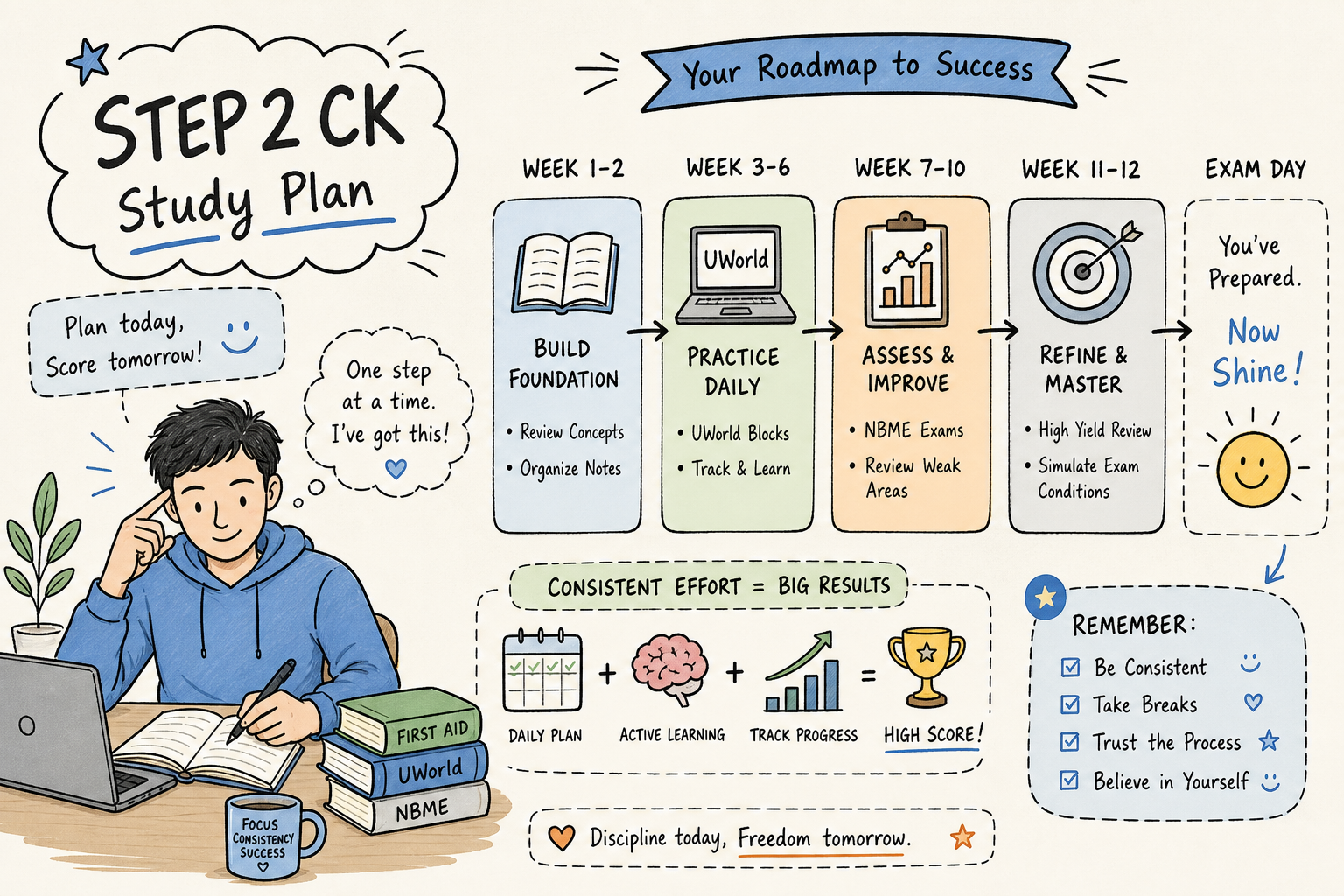
Most students lose their first week of dedicated prep not to studying, but to building their USMLE Step 2 CK study schedule. You open a browser tab, find six different frameworks, read three Reddit threads with contradictory advice, and close the laptop having accomplished nothing. That friction is real, and it costs you time you don’t have.
This article gives you a working framework: a USMLE Step 2 CK study schedule built around three distinct phases, a daily template that holds up under pressure, and concrete UWorld and NBME targets tied to your actual starting point. No fluff, no guesswork. Just a structure you can follow from Day 1.
One thing worth flagging now: one of the most consistent problems students hit mid-schedule is resource sprawl. Switching between scattered PDFs, lecture videos, and random notes costs measurable study time every single day. You’ll see later how anchoring your daily review to a single consolidated source fixes that. But first, the decision that shapes everything else: how many weeks do you actually need?
Choosing your USMLE Step 2 CK study schedule timeline
The 4-week plan: for students with a strong foundation
This timeline fits students with shelf exam scores at or above the national mean, a Step 1 pass that wasn’t a close call, and a baseline NBME sitting around 230 or higher. Four weeks is enough to complete UWorld, run three to four practice exams, and close your weakest gaps. Most sources recommend 4, 6 weeks for dedicated prep; a shorter window can work for strong performers, but keep in mind that very prolonged dedicated periods of eight weeks or more have been associated with MSPE concerns at some programs. For an evidence-based discussion about typical dedicated timelines.
The 6-week plan: the most common fit
If you have decent shelf performance, some UWorld done during rotations, and a baseline NBME in the 220 to 230 range, six weeks is your sweet spot. The structure is clean: four weeks of content and question work, two weeks of practice exams and targeted review. This is the timeline most commonly recommended across prep resources and student guides, and it works reliably when executed with consistency. Most of the framework below is built around this Step 2 dedicated study calendar.
The 8, 12 week plan: for those rebuilding from a weaker baseline
Students with shelf scores below the 15th percentile, a difficult Step 1, or a baseline NBME under 215 need more runway. Eight weeks gives you room to rebuild without burning out. The 10 to 12 week range only makes sense if you’re still rotating and can’t commit to full-time prep. At that point, it functions less like a traditional dedicated period and more like a structured pre-dedicated phase layered into your clinical schedule.
The three phases of an effective Step 2 CK study schedule
Phase 1 (weeks 1, 2): building the content foundation
Phase 1 is about establishing your knowledge base and your daily routine at the same time. Keep UWorld system-specific here: work through cardiology, pulmonology, and internal medicine blocks aligned with your weakest shelf areas. Pair each system with a short video resource to close conceptual gaps quickly, and start building your Anki habit with cards drawn directly from your UWorld wrong answers. Target 40 to 60 questions per day with full explanation review.
This is also where your review resource setup matters most. Students who enter Phase 1 pulling from five or six different sources lose significant study time each day just switching between them. Keeping your daily content review anchored to a single, well-organized recall file removes that friction entirely. RecallMastery’s Step 2 CK recall files are designed for exactly this workflow: one high-yield resource that keeps your daily review focused without requiring you to juggle multiple sources every session. Simplifying your resource stack before Phase 1 starts is one of the highest-leverage decisions you’ll make.
Phase 2 (weeks 3, 4 or 3, 6): practice volume and gap targeting
Shift from system-specific to mixed, timed UWorld blocks in Phase 2. Your daily question count moves to 80 to 120 questions across two to three blocks, and your review time stays proportionally longer than the blocks themselves. Use UWorld’s performance graphs to identify your lowest-performing subjects and direct your afternoon review there. Schedule one midpoint NBME practice exam during this phase to gauge your score trajectory before the final stretch. For concrete tips on using UWorld effectively for Step 2 CK, consult targeted guides that walk through block strategy and review workflow.
Phase 3 (final 1, 2 weeks): simulation and polishing
The last stretch is about stamina and consolidation, not new learning. Run full NBME simulations under test-day conditions: timed, no notes, no interruptions. Scale your daily question count toward 100 or more if your energy allows. Taper new Anki cards down to zero and focus entirely on reviewing your existing deck. No new resources enter your rotation at this point.
A daily Step 2 CK study schedule template that actually holds up
Morning: Qbank blocks when focus is highest
Start your day with UWorld, not passive review. The first two hours should be one to two timed 40-question blocks completed without interruption. Your working memory is sharpest early, and you want that capacity directed at active problem-solving. Keep breakfast light and pre-block, and hold Anki until later in the day when the cognitive load of new questions has already been spent.
Midday: deep review and system-targeted work
Budget two to three hours per UWorld block for review. This is not optional. Every explanation, for correct and incorrect answers alike, gets read in full. Note patterns in your wrong answers rather than isolated facts. The afternoon is also the right slot for targeted content work on your Phase 2 weak systems, using a focused recall resource or a short video to anchor the concept before your next block.
Evening: active recall and recovery
Keep the evening to 30 to 45 minutes of Anki: your daily review queue plus any new cards from the afternoon session. After 8 PM, stop studying entirely. Sleep isn’t optional, it’s when the day’s pattern recognition consolidates. Students who consistently get fewer than seven hours tend to see their practice exam performance slip, and sleep debt compounds quickly across a multi-week schedule. Protect your sleep the same way you protect your study blocks.
UWorld pacing and NBME timing done right
How to pace your UWorld blocks across the full timeline
In a six-week dedicated period, 80 questions per day puts you through roughly 3,360 questions, a solid first pass across UWorld’s Step 2 CK bank of over 4,250 questions. Scale to 100 to 120 questions per day in weeks four through six if your review depth allows. Among commonly reported high-scorer strategies, students targeting the 240 to 260 range typically complete one and a half to two full passes, with the second pass focused entirely on previous wrong answers and flagged questions. Track your overall percentage by subject weekly: anything below 60% in a system signals a content gap that needs Phase 1-level attention.
When to schedule your NBME practice exams
Take your baseline NBME at the end of Week 1, not before. One week of active prep gives you a more useful post-rotation baseline than a cold diagnostic does. Schedule a midpoint check at the end of Week 2 or mid-Week 3. Run your final readiness predictor one week before your exam date, not the day before. Space all exams seven to ten days apart to allow for meaningful review between each one.
A score progression of 10 to 15 points per exam period is a reliable signal that your approach is working. UWSA2 is widely regarded as the strongest predictor of your actual exam score and deserves a dedicated slot in your final two weeks. Based on pooled test-taker reports, UWSA2 scores tend to land within five points of actual Step 2 CK performance for most students, though those scoring in the 250-plus range may see slight overprediction. For data on how closely Step 2 CK self-assessment scores predict the real exam, consult comparative analyses of NBME and UWSA results. Use UWSA2 alongside your last one to two NBME forms for the most accurate readiness picture.
Adapting the schedule when rotations are still in the picture
A realistic modified daily template for part-time prep
If you’re still completing clinical rotations, an eight to ten hour study day isn’t possible, and chasing it leads to burnout fast. A sustainable modified template looks like this: 30 to 45 minutes of Anki before rounds, one UWorld block of 40 questions in the evening with full review, and weekly system-specific content work on your one light-rotation day. This pace extends your effective prep timeline but keeps the habit continuous rather than fragmented.
Keeping momentum without losing your schedule
The biggest risk during rotations isn’t falling behind on questions, it’s losing the daily rhythm entirely. Treat your modified schedule as non-negotiable on light days and flexible on heavy ones. Log your daily question count and weekly NBME target in a simple tracking sheet. In practice, students who track completion, even informally, tend to stay far more consistent through the unpredictability of clinical schedules. When your dedicated period finally starts, the habit is already there. You’re only scaling the volume.
Build your USMLE Step 2 CK study schedule and protect it
A Step 2 CK study schedule only works when it fits your baseline, not someone else’s. Take your baseline NBME at the end of Week 1, let that score anchor your phase structure, and build your daily template around consistent UWorld question volume and honest review time. The framework above addresses the variables that separate students who improve steadily from those who plateau mid-prep.
Build the schedule first. Then protect it like it’s the most important clinical decision you’ll make this year. Because for your score, it is.
If resource sprawl is slowing you down, simplify your review stack before your dedicated period starts. RecallMastery’s Step 2 CK recall files give you one monthly-updated, high-yield resource so you spend your study hours on the material, not on managing your sources. Free sample files are available if you want to evaluate the format before committing. Visit RecallMastery to get your copy and start your dedicated period with the right foundation in place.